|
 |
 |
 |
 |
 |
 |
 |
 |

 |
Japanese scientists eye new planet
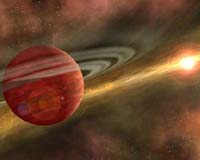
Tokyo (AFP) Feb 28, 2008 Scientists at a Japanese university said Thursday they believed another planet up to two-thirds the size of the Earth was orbiting in the far reaches of the solar system. The researchers at Kobe University in western Japan said calculations using computer simulations led them to conclude it was only a matter of time before the mysterious "Planet X" was found. "Because of the very cold temperature, its surface would be covered with ice, icy ammonia and methane," Kobe University professor Tadashi Mukai, the lead researcher, told AFP. The study by Mukai and researcher Patryk Lykawka will be published in the April issue of the US-based Astronomical Journal. "The possibility is high that a yet unknown, planet-class celestial body, measuring 30 percent to 70 percent of the Earth's mass, exists in the outer edges of the solar system," said a summary of the research released by Kobe University. "If research is conducted on a wide scale, the planet is likely to be discovered in less than 10 years," it said. Planet X -- so called by scientists as it is yet unfound -- would have an oblong elliptical solar orbit and circle the sun every thousand years, the team said, estimating its radius was 15 to 26 billion kilometres. The study comes two years after school textbooks had to be rewritten when Pluto was booted out of the list of planets. Pluto was discovered by the American astronomer Clyde Tombaugh in 1930 in the so-called Kuiper belt, a chain of icy debris in the outer reaches of the solar system. In 2006, nearly a decade after Tombaugh's death, the International Astronomical Union ruled the celestial body was merely a dwarf planet in the cluttered Kuiper belt. The astronomers said Pluto's oblong orbit overlapped with that of Neptune, excluding it from being a planet. It defined the solar system as consisting solely of the classical set of Mercury, Venus, Earth, Mars, Jupiter, Saturn, Uranus and Neptune. The team noted that more than 1,100 celestial bodies have been found in the outer reaches of the solar system since the mid-1990s. "But it would be the first time to discover a celestial body of this size, which is much larger than Pluto," Mukai said. The researchers set up a theoretical model looking at how the remote area of the solar system would have evolved over the past four billion years. "In coming up with an explanation for the celestial bodies, we thought it would be most natural to assume the existence of a yet unknown planet," Mukai said. "Based on our hypothesis, we calculated how debris moved over the past four billion years. The result matched the actual movement of the celestial bodies we can observe now," he said. He was hopeful about research by Kobe University, the University of Hawaii and Taiwan's National Central University. "We are expecting that the ongoing joint celestial observation project will eventually discover Planet X," Mukai said. Community Email This Article Comment On This Article Related Links Lands Beyond Beyond - extra solar planets - news and science Life Beyond Earth
 NASA Ames Conducts Tests Of Kepler Mission Image Detectors
 Moffett Field CA (SPX) Feb 21, 2008
Sensitive detectors that may help find habitable planets orbiting distant stars as part of NASA's Kepler Mission are undergoing tests at Ames Research Center, Moffett Field, Calif. |
|
|

| The content herein, unless otherwise known to be public domain, are Copyright 1995-2007 - SpaceDaily.AFP and UPI Wire Stories are copyright Agence France-Presse and United Press International. ESA Portal Reports are copyright European Space Agency. All NASA sourced material is public domain. Additional copyrights may apply in whole or part to other bona fide parties. Advertising does not imply endorsement,agreement or approval of any opinions, statements or information provided by SpaceDaily on any Web page published or hosted by SpaceDaily. Privacy Statement |