
 |
 |
 |
 |
 |
 |
 |
 |
 |

 |
Japanese kids get first-hand look at whale slaughter
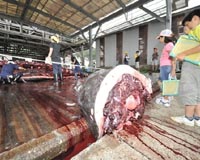
Wadamachi, Japan (AFP) June 26, 2008 As pro-whaling and pro-conservation countries square off on the other side of the globe, curious Japanese schoolgirl Yuna Suzuki, 10, got a vivid first-hand look at the issue. Yuna and a few dozen classmates from local elementary schools visited the whale slaughterhouse in Wadamachi, one of Japan's four coastal towns allowed to catch a small number of the ocean giants. Clutching a notebook and a pencil, Yuna and her classmates occupied the front row of the crowd Wednesday, bending forward to watch a 10-metre (33-foot) animal -- the town's first catch of the three-month season -- be dismembered. "Look! That's her heart!" Yuna said to her friends with her face half covered by her hand. "Oh no, so much blood is gushing out." Another schoolgirl, Honami Shoji, 11, said, "I feel bad for the animal." "But we also eat the meat and appreciate it," she said calmly. "We're lucky to be born in this town." Schoolchildren of Wadamachi, about 70 kilometres (45 miles) southeast of Tokyo, have watched the whale slaughter since 1999 in this town which is allowed to catch 26 Baird's beaked whales each season. "Students previously studied the history of whaling in this town as well as the present-day debate in which some people in the world oppose the killing of whales," said one of their teachers, Michiyo Masuda. "This is a good opportunity for them to learn about their hometown and its culture," she said. While Masuda and her colleagues insist they offer a balanced view on whaling, the global debate is anything but dispassionate. Proponents and opponents of whaling have fiercely confronted one another at meetings of the International Whaling Commission (IWC), although there were calls for a calmer debate at its annual session that opened Monday in Chile. The IWC imposed a moratorium on commercial whaling in 1986 but its rules permit the killing of the giant mammals for scientific research. The only nations to brazenly defy the IWC ban on commercial whaling are Norway and Iceland. Japan, accusing Western nations of cultural insensitivity, has lobbied for commercial whaling while continuing to kill about 1,000 of the ocean giants a year in the name of scientific research. Japan conducts most of its hunt in the Antarctic, causing friction with Australia and New Zealand and harassment by environmentalists. Greenpeace has also alleged corruption in the taxpayer-backed hunt and recently handed to prosecutors a box of whale meat which it said had been sold on the black market. Instead, prosecutors on Sunday detained two members of the environmental campaign group on allegations of stealing the meat. Despite the country's position on whaling, most Japanese consume little or no whale meat. A recent survey by the Nikkei business newspaper found that only 12 percent of Japanese in their 20s enjoyed eating whale. Whale meat is also getting more expensive. Japan's research whaling operator said Wednesday it would raise meat prices by an average of 6.1 percent due to rising fuel costs and because harassment by environmentalists reduced the total whale catch. "I used to eat whale meat all the time," said Nobuko Tanabe, 58, who rushed to the Wadamachi fishing port to buy a portion of the first catch. "This food brings back memories from childhood so much." "But we can't buy it much now because whale meat has gotten so expensive recently," she said. For 10-year-old Yuna, despite her complaint over the bloody slaughter scene, whaling in Wadamachi comes down to a much simpler matter. "I'll eat whale meat because it tastes good. I think whalers here are cool," she said. "They work very hard." Community Email This Article Comment On This Article Share This Article With Planet Earth
Related Links Follow the Whaling Debate
 Japan defends 'scientific' whale hunting at IWC
 Santiago (AFP) June 25, 2008
Japan defended its practice of 'scientific' whale hunting at the annual International Whaling Commission meeting here on Wednesday, insisting it had yielded important scientific results. |
|
|

| The content herein, unless otherwise known to be public domain, are Copyright 1995-2007 - SpaceDaily.AFP and UPI Wire Stories are copyright Agence France-Presse and United Press International. ESA Portal Reports are copyright European Space Agency. All NASA sourced material is public domain. Additional copyrights may apply in whole or part to other bona fide parties. Advertising does not imply endorsement,agreement or approval of any opinions, statements or information provided by SpaceDaily on any Web page published or hosted by SpaceDaily. Privacy Statement |
 del.icio.us
 Digg
Digg Reddit
 YahooMyWeb
 Google
 Facebook