|
 |
 |
 |
 |
 |
 |
 |
 |

 |
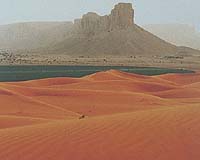
Japanese Speed Up Plant Roots To Make Desert Green
Tokyo (AFP) Dec 13, 2005 Japanese researchers say they have developed a way to make plant roots grow three times faster in a bid to begin to turn green a coastal desert in Saudi Arabia. Longer roots would help plants reach water that is often 50 to 200 centimeters (20 to 80 inches) deep in deserts, raising their chances of survival, Mitsubishi Heavy Industries said. Construction of an experimental plant-growing facility will start in Saudi Arabia sometime in the year from April 2006, said a spokesman for Mitsubishi, the main contractor of the project initiated by Japan's science ministry. The results of the research - which is supported by the Saudi government and universities in Saudi Arabia and Japan - could also be applied to many arid areas in the Middle East, Africa, India and China. "Simulation research has shown a certain level of forestation would help form clouds above and bring about rain" in regions of Saudi Arabia along the Red Sea where humid air is already flowing in, a Mitsubishi statement said. The researchers controlled the soil hardness, moisture, temperature and nutrients to make the roots of a soybean seedling grow to 38 centimeters in a cylinder over a week, compared with eight centimeters for an untreated sample. On average, the speed of growth has been three times faster by carefully managing the plants, Mitsubishi Heavy said. The method has also worked on Japanese black pines, which are close to the dates the project plans to use in Saudi Arabia, it said. Source: Agence France-Presse Community Email This Article Comment On This Article Related Links SpaceDaily Search SpaceDaily Subscribe To SpaceDaily Express Darwin Today At TerraDaily.com
 Scientists Sequence DNA Of Woolly Mammoth
 Hamilton ON (SPX) Dec 19, 2005
Experts in ancient DNA from McMaster University (Canada) have teamed up with genome researchers from Penn State University (USA) for the investigation of permafrost bone samples from Siberia. The project also involved paleontologists from the American Museum of Natural History (USA) and researchers from Russia, the United Kingdom, France, and Germany. |
|
|

| The content herein, unless otherwise known to be public domain, are Copyright 1995-2006 - SpaceDaily.AFP and UPI Wire Stories are copyright Agence France-Presse and United Press International. ESA PortalReports are copyright European Space Agency. All NASA sourced material is public domain. Additionalcopyrights may apply in whole or part to other bona fide parties. Advertising does not imply endorsement,agreement or approval of any opinions, statements or information provided by SpaceDaily on any Web page published or hosted by SpaceDaily. Privacy Statement |