|
 |
 |
 |
 |
 |
 |
 |
 |

 |
Japanese Spacecraft Fails To Touch Down On Asteroid
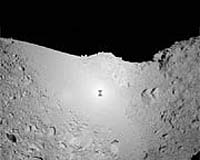
Tokyo (AFP) Nov 20, 2005 A Japanese spacecraft on Sunday failed to land on an asteroid in the second setback for the landmark mission aiming to bring samples from such a celestial body to Earth for the first time. After approaching to within meters, the Hayabusa spacecraft then drifted off to somewhere within 100 kilometers (60 miles) of the bean-shaped Itokawa asteroid -- itself 290 million kilometers (180 million miles) from Earth. "Most likely, Hayabusa didn't reach the surface," the mission's project manager Junichiro Kawaguchi told a press conference. The spacecraft had released a 'target marker', a small metal ball, 40 meters (yards) away from the asteroid at 5:30 am (2030 GMT) as planned, and managed to move to within 17 meters of the surface, said Tatsuo Oshima, an official at the Japan Aerospace Exploration Agency. The ball was to mark the point where the six-meter (20-feet) spacecraft would gather rock and sand from the 500 metre (yards) wide asteroid. The spacecraft was also meant to leave an aluminum plate bearing the names of 880,000 people from 149 countries, among them US filmmaker Steven Spielberg and British science fiction author Arthur C. Clarke, on the asteroid. But shortly afterward, Hayabusa suffered a glitch and was not able to confirm its altitude, temporarily losing contact with Earth. The spacecraft resumed transmission at 9:30 am (0030 GMT) but had drifted away from the asteroid, which rotates between Earth and Mars, Oshima said. "We believe the target marker landed on the surface because Hayabusa moved to the 17-meter point from Itokawa after the release," Oshima said. Kawaguchi said he wanted the spacecraft to try again to touch down on the asteroid on Friday as scheduled. "There is one more target maker left, so I'd like to try one more time," he said. If the mission is successful, it would be the first time that material from an asteroid is brought to Earth. It could help scientists learn more about how the solar system was created. Last Saturday, the agency lost contact with a micro-rover released from Hayabusa after the small robot failed to land on the asteroid. The lander, called Minerva and weighing less than 600 grams (21 ounces), was designed to investigate the surface of the asteroid with three small cameras. Hayabusa was launched in May 2003 with a budget of 12.7 billion yen (just over 100 million dollars) and is scheduled to return to Earth in June 2007. Japan's space program has been eyeing more ambitious projects after the humiliating failure in November 2003 to launch a spy satellite. In February, Japan sent a weather satellite into space, its first launch since the 2003 failure when the satellite had to be destroyed 10 seconds after liftoff. CommunityEmail This Article Comment On This Article Related Links SpaceDaily Search SpaceDaily Subscribe To SpaceDaily Express Asteroid and Comet Mission News, Science and Technology
 NASA'S Spitzer Finds Possible Comet Dust Around Dead Star
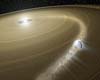 Pasadena CA (SPX) Jan 12, 2006
NASA's Spitzer Space Telescope has spotted what may be comet dust sprinkled around the white dwarf star G29-38, which died approximately 500 million years ago. |
|
|

| The content herein, unless otherwise known to be public domain, are Copyright 1995-2006 - SpaceDaily.AFP and UPI Wire Stories are copyright Agence France-Presse and United Press International. ESA PortalReports are copyright European Space Agency. All NASA sourced material is public domain. Additionalcopyrights may apply in whole or part to other bona fide parties. Advertising does not imply endorsement,agreement or approval of any opinions, statements or information provided by SpaceDaily on any Web page published or hosted by SpaceDaily. Privacy Statement |