|
 |
 |
 |
 |
 |
 |
 |
 |

 |
Japanese Scientists Discover Huge Undersea Lava Plateau
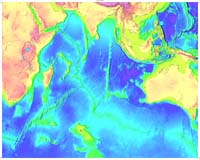
Tokyo (AFP) Jan 09, 2007 A team of Japanaese scientists said Tuesday they had discovered one of the world's biggest lava plateaus under the Indian Ocean, using an unmanned undersea probe they developed. The plateau is located in the so-called Mid Ridge in the Indian Ocean below a point 800 kilometers (500 miles) east of Mauritius, said Professor Tamaki Ura, director of the University of Tokyo's Underwater Technology Research Center. "This is presumed to be not only the biggest lava plateau in the Indian Ocean but also one of the biggest in the world," Ura said. "The vehicle also spotted hydrothermal eruptions on the northern part." The flat plateau measures about 14 kilometers (8.8 miles) in length and 2.7 kilometers (1.7 miles) in width at a depth of about 2,700 meters (8,860 feet), according to the team from the university. Ura said the plateau was covered with lava some 300 meters (980 feet) thick. The team surveyed the area last month using the undersea vehicle, codenamed r2D4, which it has developed and used in several missions including observation of an undersea hydrothermal vent near the Mariana basin last year. The vehicle is equipped with high-performance sensors, and can probe seabeds by dodging obstacles and submerge as deep as 4,000 meters (13,120 feet), Ura said.
Source: Agence France-Presse Community Email This Article Comment On This Article Related Links Making money out of watching earth from space today Earth Observation News - Suppiliers, Technology and Application
 Northrop Grumman To Develop System Requirements For USAF Alternate Infrared Sat System
 Redondo Beach CA (SPX) Jan 04, 2007
Northrop Grumman will develop system definition requirements for the U.S. Air Force's Alternate Infrared Satellite System (AIRSS) that would provide uninterrupted space-based early missile detection. |
|
|

| The content herein, unless otherwise known to be public domain, are Copyright 1995-2006 - SpaceDaily.AFP and UPI Wire Stories are copyright Agence France-Presse and United Press International. ESA PortalReports are copyright European Space Agency. All NASA sourced material is public domain. Additionalcopyrights may apply in whole or part to other bona fide parties. Advertising does not imply endorsement,agreement or approval of any opinions, statements or information provided by SpaceDaily on any Web page published or hosted by SpaceDaily. Privacy Statement |