|
 |
 |
 |
 |
 |
 |
 |
 |

 |
Japanese Researcher Finds Massive Black Hole 12.7 Billion Light-years Away
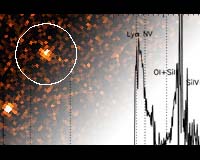
Tokyo, Japan (SPX) Sep 07, 2006 Astronomer Tomotsugu Goto from the Japan Aerospace Exploration Agency(JAXA) has used the Subaru telescope to identify a distant quasar powered by a massive black hole. The quasar is almost 12.7 billion light-years away from Earth in the direction of the constellation Cancer the Crab. It is the most distant one ever found by a Japanese researcher and the eleventh most distant quasar currently known. The black hole is probably 2 billion times more massive than the Sun. So far, researchers have not yet proposed a theory of how such a massive black hole can form only 1 billion years after the birth of the universe. Quasars are black holes in the act of actively swallowing material from surrounding space and emitting huge outbursts of energy. They are rare, and astronomers must search over a wide area of sky to find them. To locate candidate quasars, Goto searched the database of the Sloan Digital Sky Survey (SDSS) to find objects that have the same color in visible light as quasars at a distance of 12.7 billion light years. He found 300 candidates among the 180 million objects scattered in the sky in the 6,670-square-degree area of the SDSS (this covers roughly one-sixth of the sky). By observing these candidates in infrared light using the Apache Point 3.5-meter telescope and the United Kingdom Infrared Telescope on Mauna Kea, Goto was able to eliminate stars in our own galaxy that have similar visible colors to quasars. Goto then observed the remaining 26 candidates with the Faint Object Camera and Spectrograph (FOCAS) on the Subaru telescope to find what he was looking for a quasar 12.7 billion light years away. Xiaohui Fan from the University of Arizona and his collaborators who discovered the ten most distant quasars known have been the only other researchers successful in finding such distance quasars. The Goto's newly discovered quasar has a black hole that is probably 2 billion times more massive than the Sun. So far, researchers have no one has not yet proposed a theory of how such a massive black hole could have can formed only a 1 billion years after the birth of the universe. In addition, the quasar's spectrum shows that much of the hydrogen between the quasar and Earth is ionized. This suggests that something had converted neutral hydrogen to ionized hydrogen before the universe was even a billion years old, something had converted neutral hydrogen to ionized hydrogen, a mysterious event known as the reionization of the universe. The most promising solution key to understanding to the riddle of reionization is ultraviolet radiation. It comes from either stars or massive black holes. However, since reionization occurred over 12 billion years ago, getting reliable observational evidence has been a challenge. Quasars are ideal for probing the epoch of reionization because they are distant and shine brightly and stably over long periods of time. Gamma ray bursts are also extremely distant and bright, and many researchers have used them successfully to probe reionization. However, as their name implies, gamma-ray bursts only happen occasionally, and do not last a long time. Quasars are rare, nonetheless, and it takes a search over a wide area of sky to find them. To find candidate quasars, Goto searched the database of the Sloan Digital Sky Survey (SDSS) to find objects that have the same color in visible light as quasars at a distance of 12.7 billion light years. There were 300 candidates among the 180 million objects scattered in the sky in the 6670 square degree area of the SDSS, covering roughly one sixth of the sky. By observing these candidates in infrared light at the Apache Point 3.5 meter telescope and the United Kingdom Infrared Telescope on Mauna Kea, he was able to eliminate stars in our own galaxy that have similar visible colors to quasars. Goto then observed the remaining 26 candidates with the Faint Object Camera and Spectrograph (FOCAS) on the Subaru telescope to find what he was looking for - a quasar 12.7 billion light years away. Xiaohui Fan from the University of Arizona and his collaborators who discovered the ten most distant quasars known have been the only other researchers successful in finding such distance quasars. Reionization of the universe is a patchy affair, progressing faster in regions with more ionizing sources. To truly understand how this process occurs,its process, it is important to find probes of reionization in as many directions as possible and at a range of distances. Goto hopes to repeat his success with even more distant quasars This research will be published in the Monthly Notices of the Royal Astronomical Society. Community Email This Article Comment On This Article Related Links Stellar Chemistry, The Universe And All Within It Understanding Time and Space
 New Clue To Tiniest Particles
 Adelaide, Australia (SPX) Sep 06, 2006
Particle physicists around the world will be designing their next generation of billion-dollar experiments following new findings from a University of Adelaide-led research team. The Holy Grail of the world's particle physicists is to discover and describe new particles that make up the Universe's tiniest building blocks. |
|
|

| The content herein, unless otherwise known to be public domain, are Copyright 1995-2006 - SpaceDaily.AFP and UPI Wire Stories are copyright Agence France-Presse and United Press International. ESA PortalReports are copyright European Space Agency. All NASA sourced material is public domain. Additionalcopyrights may apply in whole or part to other bona fide parties. Advertising does not imply endorsement,agreement or approval of any opinions, statements or information provided by SpaceDaily on any Web page published or hosted by SpaceDaily. Privacy Statement |