|
 |
 |
 |
 |
 |
 |
 |
 |

 |
Japanese Earthquake Victims Spend Restless Night
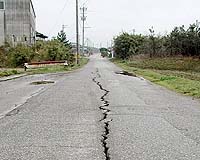
Wajima (AFP) Japan, March 26, 2007 Earthquake victims were spending a restless night in shelters early Monday as aftershocks continued to jolt Japan following a powerful quake that killed one person and injured about 170 others. More than 1,000 residents took cover in emergency shelters after the 6.9-magnitude quake hit this quiet fishing city in the Noto peninsula on the west coast of Japan's main island of Honshu. "I'm really exhausted but can't sleep," said Yoshiko Matsubara, an 80-year-old housewife, whose home was badly damaged. Walls collapsed and the house was covered with shattered glass. Matsubara was among some 30 local residents, mostly in their 50s or older, who flocked to a community hall, where some people warmed themselves by a portable stove while others helped serve food such as steamed rice and instant noodles. People cringed and looked around with fear as aftershocks, including a powerful 5.3-magnitude quake, jolted the hall almost every 30 minutes. "I couldn't use a mobile phone and the water supply was still cut off," a trembling Matsubara told AFP lying on a futon mattress. "Technology is just vulnerable to nature, isn't it?" A 52-year-old woman died after being hit by a stone lantern in a garden, while two elderly men were seriously injured after being buried by a pile of fertiliser. Tsutomu Kameoka, an 84-year-old woodcutter, said he had thought he would die without seeing such a terrible natural disaster. "But it did happen to me finally," Kameoka said quietly. "Thank God, I'm still alive but I still feel unease. My house was barely okay, but I came here because I'm not comfortable alone there." Ambulances sped through the darkness with sirens wailing, avoiding cracks on roads, some of which were covered with mud and trees following a massive landslide. At least 162 people were injured. The injuries were mostly caused by flying objects, or as people were thrown off their feet by the first powerful tremor. More than 200 buildings were damaged and 25 were completely destroyed in Wajima alone, many of them wooden houses with heavy tile roofs. Employees at convenience stores were cleaning away broken bottles which had fallen from the shelves, while local residents were working together to support brick walls with logs. "I barely survived the day but I don't know what our life is going to be like from now on," said Shigeharu Muraguchi, a 52-year-old employee at a Japanese kimono shop in Wajima. "It will take some time to restart my job as the shop was badly messed up," said Muraguchi. "I can't sleep as I think about our future." His wife, Toshiko Muraguchi, 51, said: "I dodged cans and other stuff falling on me as I was at a supermarket, where I was working. I was already tired mentally. I never dreamed this would happen to us."
Source: Agence France-Presse Community Email This Article Comment On This Article Related Links When the Earth Quakes Bring Order To A World Of Disasters Bringing Order To A World Of Disasters A world of storm and tempest When the Earth Quakes
 Cyclone Kills 36 Displaces 50000 In Madagascar
 Antananarivo (AFP) March 21, 2007
Thirty-six people were killed and nearly 54,000 people were left homeless after a cyclone struck northern Madagascar last week, according to revised figures released on Wednesday. "Today we count 36 dead and 53,750 affected people," Jacky Randriaharison, the head of national emergencies bureau BNGRC, told AFP. |
|
|

| The content herein, unless otherwise known to be public domain, are Copyright 1995-2006 - SpaceDaily.AFP and UPI Wire Stories are copyright Agence France-Presse and United Press International. ESA PortalReports are copyright European Space Agency. All NASA sourced material is public domain. Additionalcopyrights may apply in whole or part to other bona fide parties. Advertising does not imply endorsement,agreement or approval of any opinions, statements or information provided by SpaceDaily on any Web page published or hosted by SpaceDaily. Privacy Statement |