|
 |
 |
 |
 |
 |
 |
 |
 |

 |
Japan successfully launches high-speed Internet satellite
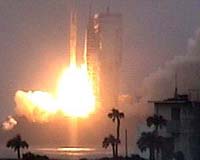
Tokyo (AFP) Feb 23, 2008 Japan successfully launched Saturday an experimental satellite aimed at providing high-speed Internet access across Asia, even when terrestrial infrastructure goes down, the space agency said. The domestically developed H-2A rocket carrying the Kizuna satellite was launched at 17:55 pm (0855 GMT) with no glitches from the Space Centre on Tanegashima island off the southern tip of Kyushu Island, southern Japan. The communications satellite, expected to be in use for five years, separated from the rocket approximately 35 minutes after the launch, said an official of the Japan Aerospace Exploration Agency (JAXA) during a live broadcast. The 342 million dollar-Kizuna will allow super-high speed data communications of up to 1.2 Gbps, which would make it the fastest in the world, the agency said. That rate would translate to 150 times that of the average high-speed ADSL connection rate of 8 Mbps, or 12 times the speed of a fibre-optic communication delivery to a person's premises (FTTP). The "Kizuna," which also means "bond" in Japanese, is expected to begin transmitting and receiving data with terrestrial infrastructures in July after completing preparations and confirming the satellite's safety. Japan is looking to use the satellite to allow communication when a ground-based network is severed by a disaster in any Asian country, in which case it would be used to transmit data to crisis management offices. The agency is hoping it can also be used as an educational or medical tool to reach people in remote or mountainous areas. "The Internet is now an integral part of our lives; but its infrastructure levels vary. Urban areas ... have a better environment, whereas some mountainous regions and remote islands are not well-equipped," JAXA said on its website. The satellite will enable students in Asian countries to communicate smoothly and with no time lag among one another, as if they were in the same classroom, it said. The satellite will to last five years, an agency spokeswoman said. The launch was delayed by one week after JAXA said it had discovered a problem with the gas jet thruster for its launch rocket. Japan, like developing Asian powers China and India, has been stepping up its space operations and has set a goal of sending an astronaut to the moon by 2020. Japan faced an embarrassing failure in November 2003, when it had to destroy a rocket carrying a spy satellite 10 minutes after lift-off because a booster failed to separate. However, Japan's first lunar probe, Kaguya, was successfully launched last September, releasing two baby satellites which will be used to study the gravity fields of the moon among other projects. The 55-billion-yen (500-million-dollar) lunar probe is the most extensive mission to investigate the moon since the US Apollo in the 1960s and 1970s. Community Email This Article Comment On This Article Related Links Launch Pad at Space-Travel.com
 Arianespace Mission Update: The ATV Has Been Integrated On Its Ariane 5 Launcher
 Kourou, French Guiana (SPX) Feb 21, 2008
Ariane 5's largest payload ever has been integrated on the launch vehicle, taking Arianespace's upcoming historic mission with the Automated Transfer Vehicle (ATV) one step closer to its March 8 liftoff. The integration process at Europe's Spaceport in French Guiana began late last week, and was concluded with the spacecraft's power-up this weekend atop the launcher. |
|
|

| The content herein, unless otherwise known to be public domain, are Copyright 1995-2007 - SpaceDaily.AFP and UPI Wire Stories are copyright Agence France-Presse and United Press International. ESA Portal Reports are copyright European Space Agency. All NASA sourced material is public domain. Additional copyrights may apply in whole or part to other bona fide parties. Advertising does not imply endorsement,agreement or approval of any opinions, statements or information provided by SpaceDaily on any Web page published or hosted by SpaceDaily. Privacy Statement |