|
 |
 |
 |
 |
 |
 |
 |
 |

 |
Japan plans world's fastest maglev train: firm
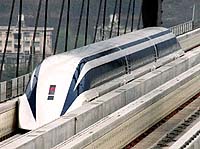
Tokyo (AFP) Dec 26, 2007 A Japanese rail operator said Wednesday it plans to introduce the world's fastest train in the next two decades, a next-generation maglev built at a cost of 45 billion dollars. "Maglev," or magnetically levitated, trains travel above ground through an electromagnetic pull. The only maglev train now in commercial operation is in Shanghai. Central Japan Railway Co. (JR Central) plans to build a maglev linear-motor train between Tokyo and central Japan at a cost of 5.1 trillion yen (44.7 billion dollars) by the 2025 financial year, a company spokesman said. "It will be the fastest train ever -- if it beats the one in Shanghai -- with a velocity of about 500 kilometres (310 miles) per hour, travelling a distance of 290 kilometres," he said. The Shanghai train, launched in 2002, travels at 430 kph for the 30.5 kilometre run from Pudong airport to the financial district, according to the Shanghai Maglev Transportation Development Co.'s website. JR Central's magnetic-levitated train hit 581 kph in 2003 in a trial run on a test course in Japan's central Yamanashi prefecture, the spokesman said. The maglev train would enter service at a time when Japan looks for a successor to its famed "Shinkansen" bullet trains, which were first rolled out to the world's awe for the 1964 Tokyo Olympics. Japan's fasted train remains the Sanyo Shinkansen run by JR West in western Japan, which travels at 300 kph. The world's fastest train using conventional railway technology is currently France's TGV, which runs at 320 kph. While the JR Central did not specify the exact location for the maglev, the company in its last annual earnings report wrote of a "first phase" between Tokyo and the central industrial hub of Nagoya. JR Central said at the time it envisioned eventually building a second phase to link Nagoya with Japan's second city of Osaka. The company's board approved the plan this week and estimated that it would leave the company with a five trillion debt when the train goes into service in the financial year to March 2026. The firm projects the train will bring in five percent additional revenue in the first year, shrinking JR Central's debt to the current level within eight years of operation, a statement said. JR Central initially had waited on the plan in hopes of government subsidies. "The reason why the plan has not moved even a bit is because the government isn't able to bankroll it," JR Central president Masayuki Matsumoto said, as quoted by the Nikkei business daily. Market players were less convinced. JR Central shares on the Tokyo Stock Exchange plummeted 100,000 yen or 8.85 percent to 1.03 million yen, despite a gain of 0.65 percent on the benchmark Nikkei-225 index. A series of other maglev projects are being planned around the world. Bavaria, Germany's richest state, said in September that it would build the country's first commercial maglev train line by 2014, connecting Munich with its airport 37 kilometres (23 miles) away. The approval of the maglev, made by engineering groups Siemens and ThyssenKrupp, came despite a test last year in which it crashed into a parked maintenance vehicle, killing 23 people. China has planned to extend is maglev from Shanghai to Hangzhou, 170 kilometres (105 miles) away, by 2010, although state media reports this year said the project could be delayed or cancelled. The United States has also been studying locations to build its first commercial maglev service, with one proposal to construct a line between Washington and Baltimore. Community Email This Article Comment On This Article Related Links Great Train Journey's of the 21st Century
 China produces first home-grown bullet train: report
 Beijing (AFP) Dec 22, 2007
China's first domestically developed high-speed bullet train, capable of reaching 300 kilometres (190 miles) per hour, rolled off the production line on Saturday, state media reported. |
|
|

| The content herein, unless otherwise known to be public domain, are Copyright 1995-2007 - SpaceDaily.AFP and UPI Wire Stories are copyright Agence France-Presse and United Press International. ESA Portal Reports are copyright European Space Agency. All NASA sourced material is public domain. Additional copyrights may apply in whole or part to other bona fide parties. Advertising does not imply endorsement,agreement or approval of any opinions, statements or information provided by SpaceDaily on any Web page published or hosted by SpaceDaily. Privacy Statement |