|
 |
 |
 |
 |
 |
 |
 |
 |

 |
Japan Mulls Increased Military Muscle Against North Korea
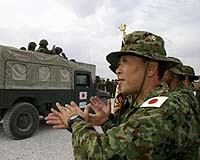
Tokyo (AFP) Jul 11, 2006 Japan is considering the need for a limited military offensive capability in case of a threat of attack from North Korea, a move which would break with 60 years of pacifism. North Korea's missile tests last week have prompted intensified debate in Japan about whether to deviate from the post-World War II constitution and to develop a full-fledged military. Chief Cabinet Secretary Shinzo Abe, who is known for his hawkish stance toward the communist state, said Monday there was need for debate on whether Japan should develop a preemptive strike capability. Defense Agency chief Fukushiro Nukaga has said Japan should consider "a limited assault capability" while Foreign Minister Taro Aso argued the right to attack before being attacked was within the scope of the constitution. Japanese forces do not currently have the capacity to attack foreign bases as their equipment is only for self-defense, a Defense Agency spokeswoman said. "Right now, Japanese troops do not have the capability to attack military bases in North Korea," agreed Akira Kato, a professor of political science at Obirin University. But the ministers' remarks would send a diplomatic message that may lead China and South Korea to increase pressure on the North, he said. "Japan has not experienced a war for more than 60 years," said Kato. So the missile firings gave "such a strong shock to the ordinary Japanese people that public support for possible preemptive attacks may gain further momentum," he added. The top-selling Yomiuri Shimbun said in an editorial Tuesday that "attacking missile bases to forestall a missile attack against Japan is an exercise of the right to self-defense allowed in the Constitution." Japan has taken the hardest line against North Korea since it test-fired seven missiles in its direction on July 5, including one long-range Taepodong-2 which is said in theory to be capable of hitting US soil. "In the past Japan's diplomatic stance was bound by the political doctrine (of pacifism), but the test-firing of the Taepodong-2 weakened that," said Takehiko Yamamoto, professor of security and politics at Waseda University. "As this debate continues, it may further aggravate Japan's already strained ties with China and South Korea," he said. South Korean President Roh Moo-Hyun's spokesman said Tuesday the Japanese comments had revealed "Japan's expansionist nature". Japan has steadily expanded its military's activity under Prime Minister Junichiro Koizumi, sending troops to Afghanistan and Iraq. Koizumi, who will step down in September, voiced caution about whether preemptive attacks would be constitutional. "It is fine to discuss measures against a possible missile launch on a theoretical basis. It is different from preemptively attacking," he said. Japan has been stepping up its military cooperation with the United States and has vowed to push ahead swiftly with joint missile defenses first prompted by the North's shock firing of a missile over the Japanese mainland in 1998. Japanese are becoming less sensitive about an expanded role for their Self Defense Forces but some still strongly oppose the idea of preemptive strikes. "I think the Japanese government is too weak. But I am absolutely opposed to strikes," said Tutsomu Katayama, a 26-year-old office worker. Yutaka Amagae, a 58-year-old businessman, said: "I am very much worried if nuclear missiles do land on Japan, but we should endure them patiently and not strike back." The ruling party already aimed to hold a national referendum on historic changes to the pacifist post-war constitution and North Korea's missile tests are only expected to harden its resolve. "I believe the government is eyeing a constitutional amendment in the near future to expand the role of the Japanese military," said Motofumi Asai, a professor of politics and a former diplomat. "What is concerning is that the government has played up the North Korean situation to the point where ordinary people cannot think calmly," said Asai, head of the Hiroshima Peace Institute at Hiroshima City University.
South Korea Says North Korea Stance Shows Japanese Return To Militarism South Korea Tuesday accused Japan of returning to its past militarism by suggesting a possible pre-emptive strike on North Korea, in a sharp split over the response to Pyongyang's missile tests. South Korea, at a meeting of top officials, renewed its condemnation of Pyongyang's missile launches last week but was unsparing in its criticism of the "arrogant" former colonial power Japan. "It is a serious development that Japanese cabinet ministers have made a series of comments that justify a possible pre-emptive strike and the use of military power against the Korean peninsula," said Jung Tae-Ho, spokesman for President Roh Moo-Hyun. "We cannot but maintain vigilance as it has unveiled Japan's expansionist nature," he said in a statement after a meeting of Roh and his top aides. Japanese officials have said they are assessing whether a pre-emptive attack on North Korea in case of an immediate threat would violate the country's pacifist 1947 constitution. The statements come amid intense debate in Japan on how far to deviate from the country's staunch post-World War II pacifism, but there is little possibility of Tokyo launching a strike in the near future. South Korea has been reconciling with the North, but its relations have recently soured with Japan, largely over how Tokyo remembers its bloody 1910-1945 occupation of the Korean peninsula. "The government has made clear that North Korea's missile tests are a provocative act that seriously undermine peace and stability in Northeast Asia," the presidential statement said. "But we will strongly deal with arrogant and reckless remarks by Japanese political leaders who try to amplify a crisis on the Korean peninsula with provocative remarks and to make an excuse to build their country into a military giant," it said. Japan on Monday met with South Korean Ambassador Ra Jong-il to complain about earlier remarks from Seoul accusing Tokyo of worsening tensions. Vice Minister for Foreign Affairs Shotaro Yachi said he had told Ra: "We are not overreacting, and it is not productive to issue such a statement." North Korea, whose official media regularly denounce Tokyo, in 1998 fired a Taepodong-1 missile that flew over Japan into the Pacific Ocean. Its latest long-range missile, the Taepodong-2, was launched last Wednesday but quickly crashed into the Sea of Japan, known here as the East Sea. South Korea on Monday also called in Japanese ambassador to Seoul Shotaro Oshima to protest a Japanese draft resolution at the United Nations to punish North Korea, a report said. "The Japanese-led draft resolution is based on Chapter Seven of the UN charter that can be interpreted as having military action as an option against North Korea," Vice Foreign Minister Lee Kyu-Hyung told Oshima, according to the JoongAng Ilbo. "The resolution's invocation of Chapter Seven of the UN charter could undermine peace and security in and around the Korean peninsula and the safety of South Koreans," he was quoted as telling him. South Korea, which is not on the UN Security Council, in 2000 launched a "sunshine policy" of reconciling with its longtime Northern adversary. It has vowed to maintain talks with the North, although it suspended crucial food and fertilizer aid to its impoverished neighbour in response to the missile tests which defied weeks of international appeals. South Korea has broken off top-level dialogue with Japan over Prime Minister Junichiro Koizumi's repeated visits to Yasukuni shrine, which honors 2.5 million Japanese war dead including 14 top war criminals from World War II. Jun Kwanwoo Contribyted to this report from Seoul
Source: Agence France-Presse Community Email This Article Comment On This Article Related Links Learn about nuclear weapons doctrine and defense at SpaceWar.com Learn about the Superpowers of the 21st Century at SpaceWar.com Learn about nuclear weapons doctrine and defense at SpaceWar.com
 It Is Broke So Fix It
 Washington (UPI) Jul 10, 2006
What can Colin Powell, John Kerry, Frank Carlucci and Zbigniew Brzezinski all agree on? The U.S. government is no longer dysfunctional; it's broken. |
|
|

| The content herein, unless otherwise known to be public domain, are Copyright 1995-2006 - SpaceDaily.AFP and UPI Wire Stories are copyright Agence France-Presse and United Press International. ESA PortalReports are copyright European Space Agency. All NASA sourced material is public domain. Additionalcopyrights may apply in whole or part to other bona fide parties. Advertising does not imply endorsement,agreement or approval of any opinions, statements or information provided by SpaceDaily on any Web page published or hosted by SpaceDaily. Privacy Statement |