|
 |
 |
 |
 |
 |
 |
 |
 |

 |
Japan Launches Spy Satellite To Watch NKorea
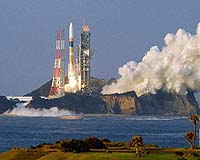
Tokyo (AFP) Sep 11, 2006 Japan on Monday successfully put into orbit its third satellite to monitor North Korea, its first launch of a spy craft since an embarrassing failure in 2003. The H-2A satellite can zoom in on objects on the ground as small as cars. With the third satellite, Japan will be able to spy on any spot in the world, officials said. The launch came two months after North Korea angered Japan by test-firing seven missiles and amid new concern that the communist state may be planning to test a nuclear bomb. The rocket carrying the H-2A satellite was launched at 1:35 pm (0435 GMT) from Tanegashima Space Center in southern Kagoshima prefecture, a space agency spokeswoman said. "I feel great," said Kunihiro Oda, head of the Cabinet Office's satellite intelligence office. "I'm glad deeply from my heart because we have accomplished the goal of gaining the ability to photograph many locations once a day," he told reporters. The satellite got into the orbit "about 16 minutes after liftoff," the space agency spokeswoman added. Outgoing Prime Minister Junichiro Koizumi, who has promoted closer military ties with Washington due to concerns over North Korea, welcomed the successful launch. "I hope Japan as an advanced nation in space technology will continue making progress in development in this area," Koizumi said on a visit to Finland. Tokyo drafted the plan to launch four spy satellites -- two of them optical and the two radar -- after North Korea shocked the world in 1998 by test-firing a long-range Taepodong-1 missile over Japan. The first pair was successfully sent into space in March 2003. But in November that year, Japan had to destroy a third spy satellite 10 minutes after liftoff. The optical satellite launched Monday travels on a polar orbit at an altitude of about 400 to 600 kilometers (250 and 370 miles), said an official from the intelligence office. With the new satellite in space, Tokyo is now capable of photographing any location in the world at least once during a day, the intelligence office said. The space agency plans to launch the second radar satellite, for photographing at night and in bad weather, early next year. "This plan is to ensure safety and defend ourselves from foreign countries," said a spokesman from the intelligence office. "But it will also be used generally for grand-scale catastrophes and is not directly linked to the specific issue of North Korea and its missile launches," he added. North Korea in July test-fired seven missiles including a new version of its Taepodong sparking international condemnation and a rebuke from the United Nations. The 2003 failure was due to problems with the rocket booster. "It was the problem with the rocket," said the space agency's spokeswoman. "The booster dragged the rocket off the initially planned track, so the satellite had to be destroyed." The humiliation came one month after China, Japan's growing neighbor and sometimes competitor, became the third country to put a human in space. Japan suspended satellite launches for more than a year after the disaster. Its satellites put into orbit since 2005 have been primarily to monitor the weather and natural disasters -- also a function of the latest satellite.
Source: Agence France-Presse Community Email This Article Comment On This Article Related Links Learn about nuclear weapons doctrine and defense at SpaceWar.com Military Space News at SpaceWar.com
 World'S Best Space Wings Honored
 Peterson AFB CO (SPX) Aug 22, 2006
Teams from 21st Space Wing, 45th SW, and 341st SW took home top honors at Air Force Space Command's Guardian Challenge 2006. The Blanchard, Aldridge and Schriever trophies were presented during a ceremony here Aug. 17. |
|
|

| The content herein, unless otherwise known to be public domain, are Copyright 1995-2006 - SpaceDaily.AFP and UPI Wire Stories are copyright Agence France-Presse and United Press International. ESA PortalReports are copyright European Space Agency. All NASA sourced material is public domain. Additionalcopyrights may apply in whole or part to other bona fide parties. Advertising does not imply endorsement,agreement or approval of any opinions, statements or information provided by SpaceDaily on any Web page published or hosted by SpaceDaily. Privacy Statement |