|
 |
 |
 |
 |
 |
 |
 |
 |

 |
Japan Launches Satellite To Probe Black Holes, Other Astronomical Phenomena
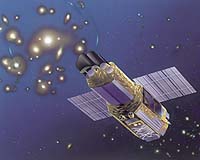
Tokyo (AFP) Jul 10, 2005 A Japanese rocket blasted off Sunday and successfully launched a satellite that will probe high-energy astronomical phenomena in a 150-million-dollar research project, the space agency said. A mid-size, solid-fuel M-5 rocket carrying the satellite lifted off from the Kagoshima Space Centre in the southern Japanese town of Uchinoura at 12:30 pm (0330 GMT), the Japan Aerospace Exploration Agency said. The satellite, code-named Astro-E2, will employ X-ray technology and is designed to "physically investigate high-energy astronomical phenomena, such as black holes and supernovae," the agency said. The government hailed the initial success of the project. "We are whole-heartedly pleased as X-ray astronomy is a field in which Japan leads the world," science minister Nariaki Nakayama said in a statement. Sunday's launch marked the fifth successful blast-off of an M-5. The only failure was the February 2000 mission designed to launch Astro-E2's predecessor. Japan hopes to put a manned station on the moon in 2025. Community Email This Article Comment On This Article Related Links SpaceDaily Search SpaceDaily Subscribe To SpaceDaily Express Space Telescope News and Technology at Skynightly.com
 Carl Zeiss And Max Planck Researchers Develop Optical Technology For JWST
 Heidelberg, Germany (SPX) Dec 09, 2005
Carl Zeiss Optronics, in Oberkochen, Germany, and the Max Planck Institute for Astronomy in Heidelberg (MPIA), are developing the main fine mechanical optical technology for two instruments to be part of the James Webb Space Telescope (JWST). |
|
|

| The content herein, unless otherwise known to be public domain, are Copyright 1995-2006 - SpaceDaily.AFP and UPI Wire Stories are copyright Agence France-Presse and United Press International. ESA PortalReports are copyright European Space Agency. All NASA sourced material is public domain. Additionalcopyrights may apply in whole or part to other bona fide parties. Advertising does not imply endorsement,agreement or approval of any opinions, statements or information provided by SpaceDaily on any Web page published or hosted by SpaceDaily. Privacy Statement |