|
 |
 |
 |
 |
 |
 |
 |
 |

 |
Japan Launches Satellite To Explore Solar Activity
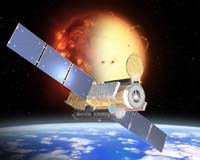
Tokyo (AFP) Sep 23, 2006 Japan on Saturday put into orbit a satellite to measure the Sun's magnetic field, giving scientists better knowledge of violent solar activity that affects the Earth. The Solar-B satellite has three telescopes that will get the closest look yet at the Sun's magnetic fields. It will orbit the Earth for three years and spend three-quarters of the time in direct sunlight. The satellite was launched from the Uchinoura Space Center in southern Japan in cooperation with the US and European space programs, which will assess the data to complement their own research. The rocket which loaded the Solar-B "succeeded" in putting the satellite into orbit, the Japan Aerospace Exploration Agency (JAXA) said on its website. The Solar-B was given the Japanese name Hinode (sunrise), it said. "The satellite will start its observation of the Sun's activity about two months later," said Satoki Kurokawa, spokesman for JAXA told AFP. The data will also be analyzed by the European Space Agency at Norway's Svalbard Islands in the Arctic Ocean, the only station on Earth that will be able to link with the Solar-B at all times. The Solar-B has three telescopes -- one optical, one X-ray and one ultraviolet -- that were designed with the United States and Britain. "It will take three weeks for the satellite to adjust its orbit to a circular path from an ellipse path which it is currently following, and then researchers will open the lids of (the) three telescopes," Kurokawa said. The Japanese researchers would lead observation of the satellite in the first six months, before it is taken over by other research institutes around the world, he said. "Solar-B represents a very important step for solar physics," said European Space Agency scientist Bernhard Fleck. "Solar-B will be able to study the solar magnetic field at scales smaller than ever before, and connect its behavior to the energetic and powerful processes at work on the Sun," he said in a statement. The Sun's magnetic field lines generate huge amounts of energy through solar flares when they interact. Coronal eruptions can affect the solar wind, bringing magnetic disturbances on Earth. The satellite follows the Solar-A, also known by its Japanese name Yohkoh, which Japan launched in 1991 in collaboration with the United States and Britain. "The success of the launch is truly a gratifying news. This is the result of our efforts to improve reliability of rockets made in Japan," said Kenji Kosaka, Japan's minister of education, culture, sports, science and technology. Japan has been gradually expanding its space program after an embarrassing failure in 2003 when it had to destroy a spy satellite 10 minutes after liftoff. On September 11 it put into orbit its third spy satellite to monitor communist neighbor North Korea. The rocket which launched the Satellite-B, the solid-fuel rocket called M-5, is the last of its kind after Japan decided to discontinue them for cost reasons. One launch costs about 7 billion yen (60 million dollars). Japan's science ministry plans to develop and launch by 2010 a new and cheaper solid-fuel rocket that will cost 2.5 billion yen per launch, but the plans needs parliamentary approval.
Source: Agence France-Presse Community Email This Article Comment On This Article Related Links Solar Science News at SpaceDaily Solar Science News at SpaceDaily
 Solar-B A New Solar Mission To Study The Dynamic Sun
 Paris, France (SPX) Sep 21, 2006
A new Japanese-led solar mission with ESA participation is preparing for launch on 23 September 2006. Solar-B will study the mechanisms which power the solar atmosphere and look for the causes of violent solar eruptions. This will lead to a better understanding of the complex connection between the Sun and Earth. |
|
|

| The content herein, unless otherwise known to be public domain, are Copyright 1995-2006 - SpaceDaily.AFP and UPI Wire Stories are copyright Agence France-Presse and United Press International. ESA PortalReports are copyright European Space Agency. All NASA sourced material is public domain. Additionalcopyrights may apply in whole or part to other bona fide parties. Advertising does not imply endorsement,agreement or approval of any opinions, statements or information provided by SpaceDaily on any Web page published or hosted by SpaceDaily. Privacy Statement |