|
 |
 |
 |
 |
 |
 |
 |
 |

 |
Japan Launches Giant Satellite For Mobile Phones
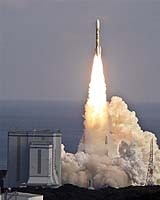
Tokyo (AFP) Dec 18, 2006 Japan on Monday launched one of the world's largest geostationary satellites in a bid to improve mobile telephone reception in remote areas. The Japan Aerospace Exploration Agency launched the H-2A rocket at 3:32 pm (0632 GMT) as planned after a postponement Saturday due to cloudy weather at the launch site at Tanegashima in southern Japan. The experimental satellite, which is known as Kiku Number 8, is the largest built by Japan's space agency. It weighs 5.8 tons and is 40 meters (131 feet) long. "The satellite successfully separated from the rocket about 30 minutes after the launch of the rocket," space agency spokesman Naohiko Kotake told a news conference at Tanegashima station. "From this point on, the satellite will continue its flight toward a stationary orbit," he said with a beaming grin as he shook hands with colleagues. Kiku Number 8's antennas, among the longest ever developed for a satellite, are its key attribute, an agency statement said. "This function is expected to be very useful in our daily lives, for example in some mountainous areas and at sea where no ground stations are available," the statement said. The satellite is also aimed at helping communication between emergency vehicles and rescue workers after natural disasters. The launch will let the space agency test the technology before potentially marketing it commercially. "The satellite will start receiving and sending data on December 25, Christmas Day, and will get into normal operation on December 26," Kotake said in the webcasted news conference. Japan's space program has gradually been stepping up activity. It had suspended launches for more than a year after an embarrassing failure in November 2003, when it had to destroy a rocket 10 minutes after lift-off because a rocket booster failed to separate. Japan hopes to send an astronaut to the moon by around 2020 and construct a manned lunar base by 2030. It was Japan's fourth launch this year of an H-2A rocket. Starting in the next fiscal year, rocket production will be contracted to private group Mitsubishi Heavy Industries, Ltd. as part of a cost-cutting drive.
Source: Agence France-Presse Community Email This Article Comment On This Article Related Links Japan Aerospace Exploration Agency The latest information about the Commercial Satellite Industry The latest information about the Commercial Satellite Industry
 The Profitability Of Space
 Moscow (UPI) Dec 14, 2006
November and December are traditional months for summing up the past year and looking ahead. A politician gages his political weight and assesses his chances in future elections. A businessman makes a close study of quotations and thinks about how to expand the market for his products. Both follow the same script, where "popularity" and "demand" are the key performers. |
|
|

| The content herein, unless otherwise known to be public domain, are Copyright 1995-2006 - SpaceDaily.AFP and UPI Wire Stories are copyright Agence France-Presse and United Press International. ESA PortalReports are copyright European Space Agency. All NASA sourced material is public domain. Additionalcopyrights may apply in whole or part to other bona fide parties. Advertising does not imply endorsement,agreement or approval of any opinions, statements or information provided by SpaceDaily on any Web page published or hosted by SpaceDaily. Privacy Statement |