|
 |
 |
 |
 |
 |
 |
 |
 |

 |
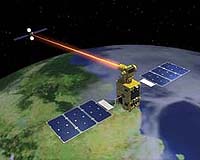
Japan And Europe Comminicate With Lasers
Tokyo - Oct 21, 2003 The National Space Development Agency of Japan (NASDA) conducted an optical communication experiment for data transmission/acquisition from September 9 to 14, 2003 between an engineering model of the Optical Inter-orbit Communications Engineering Test Satellite (OICET) and the Advanced Relay and Technology Mission (ARTEMIS) of the European Space Agency (ESA) now in orbit, and got a successful result. This experiment was to confirm pre-launch optical adaptability of OICETS with ARTEMIS by conducting two-way optical communications between ARTEMIS now in geostationary orbit and an optical communication equipment engineering model, which was installed at ESA's Optical Ground Station (OGS) located in Tenerife Island of the Spanish territory's Canarias Islands in the Atlantic Ocean. The successful result of this experiment verified the adaptability of optical equipment of two satellites, which was one of the important pre-launch verification items for OICETS. OICETS is a satellite to pursue orbital verification of element technologies, such as acquisition/tracking/pointing technologies between ARTEMIS in geostationary orbit and OICETS in low earth orbit (LEO) under international cooperation. This optical inter-orbit communication technology is important for future space activities in terms of large-volume communication and miniaturized on-board equipment. OICET is scheduled for launch in FY 2005. Community Email This Article Comment On This Article Related Links Japan Aerospace Exploration Agency OICETS Mission Page ARTEMIS SpaceDaily Search SpaceDaily Subscribe To SpaceDaily Express Space Technology News - Applications and Research
 LIGO Up And Running, But Gravity Waves Remain Elusive
 Washington DC (SPX) Jan 10, 2006
Scientists working on the Laser Interferometer Gravitational-Wave Observatory said Monday the facility has reached its target detection sensitivity, but the goal of finding the elusive phenomena known as gravity waves remains as elusive as ever. |
|
|

| The content herein, unless otherwise known to be public domain, are Copyright 1995-2006 - SpaceDaily.AFP and UPI Wire Stories are copyright Agence France-Presse and United Press International. ESA PortalReports are copyright European Space Agency. All NASA sourced material is public domain. Additionalcopyrights may apply in whole or part to other bona fide parties. Advertising does not imply endorsement,agreement or approval of any opinions, statements or information provided by SpaceDaily on any Web page published or hosted by SpaceDaily. Privacy Statement |