|
 |
 |
 |
 |
 |
 |
 |
 |

 |
James Webb Space Telescope Has A Healthy Spine
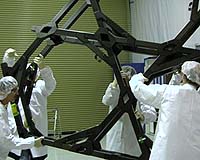
Greenbelt MD (SPX) Jan 31, 2007 The "spine" of the James Webb Space Telescope, called the backplane, is in great health for space, according to scientists and engineers. Recent tests show that the backplane, which supports the big mirrors of the telescope, can handle its trip into space and operate correctly when the observatory launches in 2013. The James Webb Space Telescope (JWST) will explore many wonders in space - from distant galaxies to nearby planets and stars. From the first light after the Big Bang to the formation of star systems that can support life on planets like Earth, JWST will give scientists clues about the formation of the universe and the evolution of our own solar system. The telescope is as big as a two-story house and involves 10 different technologies. Engineers thoroughly test each of them to make sure that it can do what it's intended to do, and that it can survive the trip into space and a life in the harsh space environment. The technologies are both hardware (like the backplane) and computer software. The backplane endured freezing conditions during the "health tests" at NASA's Marshall Space Flight Center in Huntsville, Ala. It is the largest structure ever tested in freezing temperatures, a necessary step to make sure it won't move in extreme cold. "We need it to hold steady while we're observing," said Dr. John Mather, JWST Senior Project Scientist at NASA's Goddard Space Flight Center in Greenbelt, Md. "These tests show that it will do that," he said. The movements were so small they were measured in nanometers (one nanometer is smaller than a human hair). The backplane was tested in cold as low as minus 405 degrees Fahrenheit (30 Kelvin) to minus 351 Fahrenheit (60 Kelvin) over periods lasting two to three days. From late June through mid-September, the tests took place in a special vacuum chamber at Marshall's X-Ray Calibration Facility. All of the JWST technologies have to pass this same test. If they all pass, it means these hardware and software systems can handle their space trip and work in space. Scientists and engineers then "engineer" them, or apply them, to make them work with other technologies on JWST. Northrop Grumman Corporation leads a team that is designing and building JWST under a contract with NASA. "These results represent a tremendous achievement for the JWST team," noted Martin Mohan, Northrop Grumman's JWST program manager. "The backplane performed even better than expected and demonstrates the telescope's ability to stay accurately focused." Community Email This Article Comment On This Article Related Links James Webb Space Telescope at NASA Goddard Space Flight Center All about the technology of space and more Space Telescope News and Technology at Skynightly.com
 The James Webb Space Telescope Model Gets Around
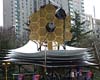 Seattle WA (SPX) Jan 30, 2007
The American Astronomical Society (AAS) held their annual meeting in Seattle, Washington during the second week in January, and Dr. John Mather, Nobel Prize winning scientist at NASA Goddard was there to talk about the James Webb Space Telescope (JWST). JWST is scheduled for launch in 2013. JWST will find the first galaxies that formed in the early Universe, connecting the Big Bang to our own Milky Way Galaxy. |
|
|

| The content herein, unless otherwise known to be public domain, are Copyright 1995-2006 - SpaceDaily.AFP and UPI Wire Stories are copyright Agence France-Presse and United Press International. ESA PortalReports are copyright European Space Agency. All NASA sourced material is public domain. Additionalcopyrights may apply in whole or part to other bona fide parties. Advertising does not imply endorsement,agreement or approval of any opinions, statements or information provided by SpaceDaily on any Web page published or hosted by SpaceDaily. Privacy Statement |