
 |
 |
 |
 |
 |
 |
 |
 |
 |

 |
James Clerk Maxwell Telescope Searches Dark Hearts Of Bright Galaxies
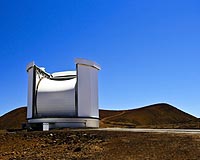
Mauna Kea HI (SPX) Nov 03, 2008 Using the James Clerk Maxwell Telescope (JCMT), astronomers from the Netherlands, the United Kingdom and Germany have obtained important information on some of the most spectacular objects in the present-day universe. Ultraluminous Infrared Galaxies (ULIRGs) are characterized by an enormous energy output, which is totally hidden from view for optical telescopes by massive gas and dust clouds inside these galaxies. When the universe was much younger, such galaxies were much more common than now, and scientists believe that galaxies of this type have played a key role in shaping the present-day universe. Their enormous energy output is attributed to extremely rapid conversion of the available gas into young, luminous stars, and to energetic processes associated with supermassive black holes. Astronomers Kate Isaak (Cardiff University, United Kingdom), Paul van der Werf (Leiden University, The Netherlands) and Padeli Papadopoulos (Bonn University, Germany) have recently used the JCMT to probe the physical conditions in the active inner regions of a number of ULIRGs directly. Dr Papadopoulos says: "The submillimetre radiation observed by the JCMT can penetrate the dust shroud obscuring the nuclear regions of the ULIRGs, but the spectral lines emitted from these regions are still very faint. Therefore, we had to use the JCMT and its sensitive HARP receiver for up to 12 hours under very good atmospheric conditions, to detect just a single line in a single galaxy." "These spectra are among the deepest ever obtained with the JCMT", says Professor Gary Davis, the Director of the James Clerk Maxwell Telescope. "They demonstrate the extraordinary sensitivity of HARP, our new, state-of-the-art receiver. It is rewarding to see new science discoveries emerging which would previously have been impossible." Dr Isaak says: "Even future satellites will not be able to supply us with all the information we need to probe the conditions within these galaxies: the JCMT with its large collecting area provides essential pieces in the puzzle." Among the molecular fingerprints that the team has observed are spectral lines of warm and dense carbon monoxide (CO) and of the formyl ion (HCO+). However, the most prized spectral line observed by the team is hydrogen cyanide (HCN). This line originates from warm, dense (and highly toxic) hydrogen cyanide gas in the most active regions of the ULIRGs. These are the first spectra of this type from a substantial set of ULIRGs, and they have been proven to be surprisingly difficult to detect in many of these extreme objects. When interpreted together with the rest of the data, it becomes obvious that this spectral line probes the most extremely dense gas, the very immediate fuel of the massive star formation in these objects. As Dr van der Werf explains: "Unlike other spectral lines which probe more remote gaseous regions in these galaxies which may not be actively forming stars, the hydrogen cyanide intensity changes dramatically from galaxy to galaxy. This depends on, and reveals, the intense gravitational tides and their effects on the densest of the gas phases in the centres of the ULIRGs." Dr Antonio Chrysostomou, Associate Director of the James Clerk Maxwell Telescope, says: "To try and place these observations in context, keep in mind that these photons had to traverse not only across their host galaxies but also over 500 million light years of inter-galactic space before reaching our Galaxy. Then consider that when they arrive at the Earth, the energy they carry is no larger than six- to three-thousandths of a degree Centigrade, and for us to be able to detect this energy our instrumentation needs to be at least three times more sensitive still." The team is currently continuing its study of ULIRGs with the JCMT by observing gas that is dense and hot, and therefore even more directly associated with the formation of young stars. This requires not only the large collecting area of the JCMT and the most favorable observing conditions, but also the newly commissioned very high frequency receiver W/D operating at 690 Ghz, one of the highest frequencies that can be observed from the ground. This is possible from only very few places on the planet. Mauna Kea, with its commanding heights and the extremely dry conditions that can occur there, is one of those places where such observations are possible. Community Email This Article Comment On This Article Share This Article With Planet Earth
Related Links James Clerk Maxwell Telescope Space Telescope News and Technology at Skynightly.com
 Scientists Selected For New Airborne Eye On The Universe
 Moffett Field CA (SPX) Oct 24, 2008
On behalf of NASA, the Universities Space Research Association, Columbia, Md., has selected three astronomers to participate in the first scientific observations to be conducted by the Stratospheric Observatory For Infrared Astronomy (SOFIA), a highly modified Boeing 747SP aircraft that carries a 2.5-meter (98-inch) diameter airborne infrared telescope. |
|
|

| The content herein, unless otherwise known to be public domain, are Copyright 1995-2007 - SpaceDaily.AFP and UPI Wire Stories are copyright Agence France-Presse and United Press International. ESA Portal Reports are copyright European Space Agency. All NASA sourced material is public domain. Additional copyrights may apply in whole or part to other bona fide parties. Advertising does not imply endorsement,agreement or approval of any opinions, statements or information provided by SpaceDaily on any Web page published or hosted by SpaceDaily. Privacy Statement |
 del.icio.us
 Digg
Digg Reddit
 YahooMyWeb
 Google
 Facebook