|
 |
 |
 |
 |
 |
 |
 |
 |

 |
JHU-Led Team Discovers Exotic Relatives Of Protons And Neutrons
Baltimore Md (SPX) Nov 17, 2006 A team of scientists, including four at The Johns Hopkins University, has discovered two new subatomic particles, rare but important relatives of the familiar, commonplace proton and neutron. Named "Sigma-sub-b" particles, the two exotic and incredibly quick to decompose particles are like rare jewels mined from mountains of data, said team leader Petar Maksimovic, assistant professor of physics and astronomy in the university's Krieger School of Arts and Sciences. "These particles are members of what we call the 'baryonic' family, so-called for the Greek word 'barys,' which means heavy," Maksimovic said. "Baryons are particles that contain three quarks, which are the fundamental building blocks of matter." The simplest baryons are the proton and neutron, which make up the nuclei of atoms of ordinary matter. "These newest members of that family are unstable and ephemeral, but they help us to understand the forces that bind quarks together into matter," Maksimovic said. Containing the second-heaviest quark - called "the bottom quark" - the new particles are the heaviest baryons found yet: heavier even than a complete helium atom, which has two protons, though lighter than a lithium atom, which has three. How rare is Sigma-sub-b? The team combed through a hundred trillion proton-antiproton collisions at the Tevatron, the world's most powerful particle accelerator, to find about 240 Sigma-sub-b candidates, Maksimovic said. The new particles are extremely short-lived, decaying within a tiny fraction of a second. "Little by little, we are compiling an ever-clearer picture of how quarks build matter and how subatomic forces hold quarks together and tear them apart," said Maksimovic, who noted that the discovery -- confirming the expectation of theorists that Sigma-sub-b particles exist -- helps complete the so-called "periodic table of baryons." There are six different types of quarks: up, down, strange, charm, bottom and top (u, d, s, c, b and t). One of the new baryons discovered by the CDF experiment is made of two up quarks and one bottom quark (u-u-b), the other of two down quarks and a bottom quark (d-d-b). For comparison, protons are u-u-d combinations, while neutrons are d-d-u. The Tevatron collider helped the team of physicists to recreate the conditions present in the early formation of the universe, reproducing the exotic matter that was abundant in the moments after the big bang. While the matter around us is constructed with only up and down quarks, exotic matter contains other quarks as well, according to Maksimovic. The Tevatron is located at the Department of Energy's Fermi National Accelerator Laboratory, also known as Fermilab, in Batavia, Ill. Led by Maksimovic, the team also included Johns Hopkins graduate student Jennifer Pursley, former undergraduate student Michael Schmidt and post-doctoral fellow Matthew Martin, along with five other scientists from Fermilab and the University of New Mexico. All are members of the collaboration of 700 physicists working on the CDF detector at Fermilab. The Tevatron accelerates protons and antiprotons close to the speed of light and makes them collide. In the collisions, energy transforms into mass, according to Einstein's famous equation E=mc^2. The odds of producing bottom quarks -- which in turn transform into the Sigma-sub-b, according to the laws of quantum physics -- are extremely low. But scientists were able to beat the low odds by producing billions of collisions in the Tevatron each second. "It's amazing that scientists can build a particle accelerator that produces this many collisions, and equally amazing that the CDF collaboration was able to develop a particle detector that can measure them all," said CDF co-spokesman Rob Roser of Fermilab. "We are confident that our data hold the secret to even more discoveries that we will find with time." Community Email This Article Comment On This Article Related Links Fermilab Maksimovic's Web page Johns Hopkins University All about the technology of space and more Understanding Time and Space
 Spinning Black Hole Pushes The Limit
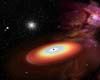 Cambridge MA (SPX) Nov 17, 2006
The existence of black holes is perhaps the most fascinating prediction of Einstein's Theory of General Relativity. When any mass, such as a star, becomes more compact than a certain limit, its own gravity becomes so strong that the object collapses to a singular point, a black hole. In the popular mind, this immense gravity well is a place where strange things happen. |
|
|

| The content herein, unless otherwise known to be public domain, are Copyright 1995-2006 - SpaceDaily.AFP and UPI Wire Stories are copyright Agence France-Presse and United Press International. ESA PortalReports are copyright European Space Agency. All NASA sourced material is public domain. Additionalcopyrights may apply in whole or part to other bona fide parties. Advertising does not imply endorsement,agreement or approval of any opinions, statements or information provided by SpaceDaily on any Web page published or hosted by SpaceDaily. Privacy Statement |