Energy News  
JAXA Says Probe Touched Down On Asteroid

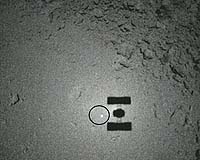
Target marker dropped by Hayabusa (a bright spot) can be seen on the surface of asteroid Itokawa. Spacecraft shadow is cast upon the space rock. Image Credit: JAXA/ISAS.

Tokyo (AFP) Nov 23, 2005
A Japanese spacecraft successfully touched down on an asteroid as part of a landmark mission, but failed to drop equipment to collect samples, Japan's space agency said Wednesday.

The Japan Aerospace Exploration Agency (JAXA) had previously said that the attempted landing on Sunday failed after the Hayabusa space probe suffered a glitch and was unable to confirm its altitude.

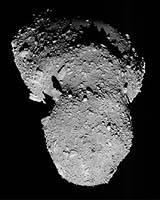
However, the agency said in an update that the spacecraft in fact managed to touch down on the bean-shaped Itokawa asteroid, located 290 million kilometers (180 million miles) from Earth for about 30 minutes, Kyodo News reported.

It was the first landing by a Japanese space vehicle on an astronomic object, the agency said.

JAXA will decide Thursday whether to make a second attempt to land Hayabusa. Although the body of the probe has not suffered any major damage, some of its censors need to be checked, the agency said.

If the mission succeeds it would be the first time that material from an asteroid is brought to Earth, and could help scientists learn more about how the solar system was created.

JAXA said last Friday that the spacecraft had released a "target marker", a small metal ball, 40 meters (132 feet) from the asteroid to mark the point where the six-meter spacecraft would gather rock and sand from the 500-metre-wide celestial body.


Community
Email This Article
Comment On This Article

Related Links
SpaceDaily
Search SpaceDaily
Subscribe To SpaceDaily Express
Asteroid and Comet Mission News, Science and Technology


Memory Foam Mattress Review
Newsletters :: SpaceDaily :: SpaceWar :: TerraDaily :: Energy Daily
XML Feeds :: Space News :: Earth News :: War News :: Solar Energy News


NASA'S Spitzer Finds Possible Comet Dust Around Dead Star
Pasadena CA (SPX) Jan 12, 2006
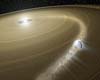
NASA's Spitzer Space Telescope has spotted what may be comet dust sprinkled around the white dwarf star G29-38, which died approximately 500 million years ago.


  • SatCon To Join GA's Superconducting DC Homopolar Motor Development Team
  • Clean Energy Changes Life Of People In Remote Regions
  • Argonne Researchers Discover Ways To Make Magnets Last Longer
  • Nigeria's High Court Determines Gas Flaring Illegal

  • Blair Pressed Over Nuclear Power Option, Depsite Costs
  • US Unblocks Foreign Military Financing For Indonesia
  • Blair Looking At 'All Options' Amidst British Nuclear Debate
  • Blair Urged To Approve New Generation Of Nuclear Reactors

  • Getting To The TOPP Of Houston's Air Pollution
  • Scientists Seek Sprite Light Source


  • India To Protect Its Farmers
  • Conservationists Appalled By Thailand's Buffet Of Exotic Wildlife
  • Tomatosphere: Tomato Seeds In Students' Hands, After 18 Months In Space
  • Australia Seeks More Palatable Name For Kangaroo Steaks

  • GM Hires Russian Nuclear Scientists To Develop New Auto Technology
  • Japan Creates The World's Fastest Electric Sedan
  • Motorists To Pay 'Congestion' Charge Over Broader Swath Of London
  • Solar Cars Driving Towards A Hydrogen Future

  • Geneva Aerospace Extends Its Flight Tech To Raspet's Ultra-Light Glider
  • NGC's E-10A Multi-Sensor Command-And-Control Aircraft Program Concludes Platform Design Review
  • New Wind Tunnel Aimed At Making Airplanes Quieter To Those On Ground
  • L-3 Communications' SPAR Aerospace Launches Herc 2020

  • NASA plans to send new robot to Jupiter
  • Los Alamos Hopes To Lead New Era Of Nuclear Space Tranportion With Jovian Mission
  • Boeing Selects Leader for Nuclear Space Systems Program
  • Boeing-Led Team to Study Nuclear-Powered Space Systems

  • The content herein, unless otherwise known to be public domain, are Copyright 1995-2006 - SpaceDaily.AFP and UPI Wire Stories are copyright Agence France-Presse and United Press International. ESA PortalReports are copyright European Space Agency. All NASA sourced material is public domain. Additionalcopyrights may apply in whole or part to other bona fide parties. Advertising does not imply endorsement,agreement or approval of any opinions, statements or information provided by SpaceDaily on any Web page published or hosted by SpaceDaily. Privacy Statement