|
 |
 |
 |
 |
 |
 |
 |
 |

 |
JAXA Launches Space Telescope
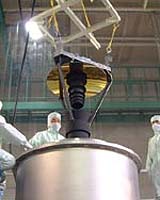
Uchinoura Space Center, Kagoshima (SPX) Feb 22, 2006 JAXA launched its ASTRO-F infrared space telescope aboard an M-5 rocket at 6:28 a.m. local time Wednesday, the BBC and Xinhua news services reported. The launch had been delayed 48 hours due to heavy rains. European and Japanese astronomers will use the ASTRO-F to compile the All-Sky Survey, a map of objects in the universe that glow in infrared wavelengths. The mission is scheduled to last 500 days, and the spacecraft will follow a polar orbit. ASTRO-F marked JAXA's third launch of 2005, but only the first from Ochinoura. Earlier this year, the agency launched two H-2A rockets carrying observation satellites from the remote southern island of Tanegashima. ASTRO-F carries an instrument called the Infrared Imaging Surveyor, or IRIS, which employs a 70-centimeter telescope cooled to 6 degrees Kelvin - or 6 degrees above absolute zero - using liquid helium. Japan's Institute of Space and Astronomical Sciences will manage the ASTRO-F mission, its 21st. The ASTRO-F project has been underway since 1997. The Uchinoura Space Center launches sounding rockets and scientific satellites and also manages tracking and data. The center began operations in 1962, and has launched more than 360 rockets since then, among them 23 satellites and probes, launched since Japan's first satellite, Osumi, was placed into orbit in 1970. Community Email This Article Comment On This Article Related Links JAXA ASTRO-F Infrared Space Telescope Uchinoura Space Center Space Telescope News and Technology at Skynightly.com
 Japan Aims For New Space Success With Galactic Survey
 Tokyo, Japan (AFP) Feb 21, 2006
Japan plans to launch on Wednesday its third satellite in under a month to research how galaxies are born as it seeks to bolster confidence in its space program after a series of setbacks. |
|
|

| The content herein, unless otherwise known to be public domain, are Copyright 1995-2006 - SpaceDaily.AFP and UPI Wire Stories are copyright Agence France-Presse and United Press International. ESA PortalReports are copyright European Space Agency. All NASA sourced material is public domain. Additionalcopyrights may apply in whole or part to other bona fide parties. Advertising does not imply endorsement,agreement or approval of any opinions, statements or information provided by SpaceDaily on any Web page published or hosted by SpaceDaily. Privacy Statement |