
 |
 |
 |
 |
 |
 |
 |
 |
 |

 |

Rome (UPI) Dec 24, 2010 Italy says it plans to build a $525 million particle accelerator using parts from a defunct American atom smasher. The Italian Ministry for Education, University and Research has approved funding for the machine, to be known as SuperB, to study the properties of subatomic particles in search of new physics knowledge, AAAS ScienceMag.org reported Friday. SuperB will be constructed utilizing parts from a defunct particle accelerator called PEP-II that ran at the SLAC National Accelerator Laboratory in Menlo Park, Calif., from 1999 to 2008. Roberto Petronzio, president of Italy's National Institute of Nuclear Physics, says he hopes the Italian ministry will agree to a construction schedule early next year and that SuperB will start producing results around 2016. The construction of SuperB is contingent on the U.S. Department of Energy contributing the machinery of PEP-II, worth more than $131 million. David MacFarlane, SLAC associate director, says the lab and the agency are onboard with the project. "Both DOE and the laboratory are fully committed to supplying the equipment requested," he said. David Hitlin, a particle physicist at the California Institute of Technology in Pasadena, says SuperB represents a scientific bargain. "DOE can be a major player in the project for a relatively small amount of money by leveraging the in-kind contribution" of the equipment, he says.
Share This Article With Planet Earth
Related Links Understanding Time and Space

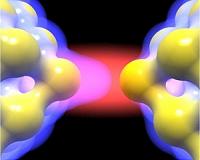 Rice Researchers Take Temperature Of Molecule
Houston TX (SPX) Dec 14, 2010 You can touch a functioning light bulb and know right away that it's hot. Ouch! But you can't touch a single molecule and get the same feedback. Rice University researchers say they have the next best thing - a way to determine the temperature of a molecule or flowing electrons by using Raman spectroscopy combined with an optical antenna. A new paper from the lab of Douglas Natelson, ... read more |
|
|
| The content herein, unless otherwise known to be public domain, are Copyright 1995-2010 - SpaceDaily. AFP and UPI Wire Stories are copyright Agence France-Presse and United Press International. ESA Portal Reports are copyright European Space Agency. All NASA sourced material is public domain. Additional copyrights may apply in whole or part to other bona fide parties. Advertising does not imply endorsement,agreement or approval of any opinions, statements or information provided by SpaceDaily on any Web page published or hosted by SpaceDaily. Privacy Statement |


 del.icio.us
 Digg
Digg Reddit
 YahooMyWeb
 Google
 Facebook


