|
 |
 |
 |
 |
 |
 |
 |
 |

 |
It Isn't A UFO, It's A Space-Age Car
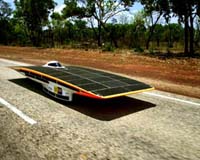
Oslo, Norway (ESA) Aug 11, 2004 The world's fastest solar-powered car is being driven through Sweden and Norway. Nuna 2, the world's fastest solar-powered car begins its journey on 14 August in Oslo and completes it on 22 August in Andenas. It will primarily be driven on the E4, and will stop in Gothenburg, Linkoping, Stockholm, Uppsala, Lulea, Kiruna, Narvik, and Andenas. There is also the possibility of short stops in other locations. "Journalists and photographers will also be able to take a look at the car at other locations near the route. Just call me and we'll stop at an agreed location along the way," says Rosita Suenson, ESA's project manager for Nuna's journey through Sweden. The car was made with the help of space technology and can reach a top speed of 170 km/h. Nuna 2 is powered by solar energy and is covered entirely by solar cell panels. "Space research and space technology have driven technical development forward in several areas, and the knowledge can be re-used in new contexts on Earth. Nuna 2 is a project that can illustrate and serve as an inspiration for new applications of space technology," says Rosita Suenson. By travelling 3010 km in 31 hours and five minutes, Nuna 2 won the World Solar Challenge in Australia in October 2003. The car was built and driven by students from Delft University in The Netherlands. In Sweden, students from the Civil Engineering Programme in Space Technology in Kiruna, one of many space programmes in Sweden, are also participating. Community Email This Article Comment On This Article Related Links SpaceDaily Search SpaceDaily Subscribe To SpaceDaily Express Space Technology News - Applications and Research
 Industry Team Achieve New Communications Technology With AESA Radars
 Baltimore MD (SPX) Jan 12, 2006
A team comprised of three leading US aerospace and defense contractors has demonstrated an innovative technological use of active electronically scanned array (AESA) radars for high-bandwidth communications. |
|
|

| The content herein, unless otherwise known to be public domain, are Copyright 1995-2006 - SpaceDaily.AFP and UPI Wire Stories are copyright Agence France-Presse and United Press International. ESA PortalReports are copyright European Space Agency. All NASA sourced material is public domain. Additionalcopyrights may apply in whole or part to other bona fide parties. Advertising does not imply endorsement,agreement or approval of any opinions, statements or information provided by SpaceDaily on any Web page published or hosted by SpaceDaily. Privacy Statement |