|
 |
 |
 |
 |
 |
 |
 |
 |

 |
Israel's Shavit Launches SpySat
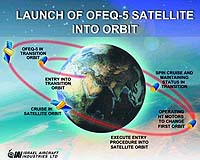
Tel Aviv - May 28, 2002 Israel Aircraft Industries (IAI), in cooperation with other Israeli hi-tech industries, launched its OFEQ-5 satellite, by means of the Israeli SHAVIT launcher, developed and produced by IAI's launch division. The satellite was launched Westward today 28 May 2002 at 18:25 pm (Israel time [15:25 UTC]). With its insertion into orbit, OFEQ-5 will undergo a series of in-orbit tests, expected to last several weeks, to verify its operation and performance. The satellite carries a remote sensing payload that will enable it to perform its high-resolution observation missions for national needs. IAI/ MBT Division developed OFEQ-5. Its design is based on proven technologies employed in the OFEQ satellites, and, on latest developments using leading edge technologies. OFEQ-5 is a three-axes stabilized, lightweight satellite platform, adapted for high-resolution observation, scientific, or, technological payloads. The satellite circles the Earth, from East to West, every hour and a half, at an approximate angle of inclination 143 degrees. OFEQ-5 is designed to operate at altitudes between 370 and 600 km above the surface of the Earth. Its projected lifetime is approximately four years. OFEQ-5 belongs to the class of small and lightweight satellites. Its launch weight is about 300 kg, has a height of 2.3 meters and 1.2 meter diameter. OFEQ-5 continues IAI/MBT's tradition of unique lightweight satellites that provide high-resolution images. OFEQ-5's lightweight allows for maximum agility over target to yield rapid image acquisition. It acquires images in swaths ahead of satellite trajectory, beneath it and lateral to it. IAI/MBT Division is the prime contractor for The Israel Space Agency. It houses the OFEQ-5 satellite ground control center. This facility serves as the National Space Center for the State of Israel. Israel's space heritage was acquired at IAI/MBT Division, not only in observation satellites, but in communications satellites, as well. The first communications satellite AMOS 1 was launched in 1996, and its communications services are marketed by SPACECOM, in Israel and in Central Europe. AMOS 2 will be launched in 2003 for SPACECOM. MBT is also developing the AMOS HP, a powerful communication satellite for HKSTG Company, Hong Kong. The AMOS HP satellite will provide communication services over Asia. In the field of observation satellites, IAI/MBT Division also manufactures the EROS (Earth Resources Observation Satellite) series of commercial high resolution observation satellites for ImageSat International (ISI) Ltd. EROS-A, the first in the constellation, was launched successfully in 2000. MBT is currently developing the EROS B satellite, planned to be launched in the first half of 2004. Concurrent with the various observation and communication satellite programs, IAI/MBT leads Israel's activity in micro-satellite development , for various applications, cooperating with overseas partners. IAI/MBT Division holds about 25% of the ownership of SPACECOM, about 44% of ISI, and a partial holding in HKSTG as well. The OFEQ-5 launch is an important step in the enhancement of the technological and space development capabilities of IAI/MBT. The SHAVIT Launcher The global market trend towards the use of smaller satellites for remote sensing, telecommunications, science and other commercial, civilian and military applications is the major driver for MLM the Systems Division of Israel Aircraft Industries (IAI) to offer orbit insertion services using its SHAVIT family of satellite launchers. IAI/MLM's Division SHAVIT launcher offers various options for launching small satellites into Low Earth Orbit (LEO). The launch system is based on flight-proven hardware and software, and a unique integration and launch concept. These reduce significantly launch preparation time, and, consequently lower overall launch costs. SHAVIT is a three-stage satellite launcher, powered by three solid fuel rocket motors. The first two stages lift the launcher to an altitude of approximately 110 km. From this point, the launcher continues to gain height while coasting up to approximately 250 km, where the launcher positions itself and ejects the satellite shroud. After the separation of the main instrumentation compartment and while the launcher is spinning, the third stage motor is ignited. Thus, the satellite is inserted accurately into its transfer orbit at an altitude of approximately 260 km. SHAVIT utilizes a unique set of launch preparation equipment. It is largely independent of the launch site and provides full testing of the launcher on the launch pad. This configuration enables satellite launch from different launch sites, according to customer requirements. The LEOLINK program was initiated to market IAI/MLM Division's launch services for the global market using the current LK-A launcher, while developing LK-1, its next generation launcher.
IAI/MLM Division leads the Israeli space industry into the international commercial satellite launching market. Through strategic alliances, and constantly improving its launcher diversity, MLM continues to pursue multi-sensor micro satellite and airborne launching capabilities further improving its competitive position in this market. Community Email This Article Comment On This Article Related Links Israel Aircraft Industries SpaceDaily Search SpaceDaily Subscribe To SpaceDaily Express Military Space News at SpaceWar.com
 GD Completes First Conversion Of Subs For US Navy Transformational Program
 Bremerton WA (SPX) Jan 10, 2006
General Dynamics Electric Boat has completed its conversion of USS Ohio (SSGN-726), the first of four Trident submarines to be reconfigured as multimission vessels optimized for covert tactical strike and special operations support. Electric Boat is a wholly owned subsidiary of General Dynamics. |
|
|

| The content herein, unless otherwise known to be public domain, are Copyright 1995-2006 - SpaceDaily.AFP and UPI Wire Stories are copyright Agence France-Presse and United Press International. ESA PortalReports are copyright European Space Agency. All NASA sourced material is public domain. Additionalcopyrights may apply in whole or part to other bona fide parties. Advertising does not imply endorsement,agreement or approval of any opinions, statements or information provided by SpaceDaily on any Web page published or hosted by SpaceDaily. Privacy Statement |