|
 |
 |
 |
 |
 |
 |
 |
 |

 |
Israel Seeks New Technology To Shoot Down Rockets From Gaza
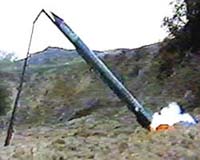
Jerusalem (AFP) Nov 23, 2006 Israel is seeking new ways to intercept Palestinian rockets fired from the Gaza Strip in mid-flight as its military proves unable to stop daily rocket fire from the territory, a senior official told AFP Thursday. Palestinian militants in Gaza have fired thousands of the homemade Qassam rockets at neighbouring Israeli communities in the past six years in attacks that have killed 10 people. But despite constant aerial surveillance and regular ground incursions into launch areas, the Israeli military has so far had no success in preventing attacks from rockets which can be fired within seconds from well-hidden sites. A senior Israeli official told AFP that the military is now seeking a technological solution to intercept the short-range rockets. "Israel is examining several options for stopping the Qassam," he said. "Two possibilities are based on existing Israeli technology and two others on American weaponry." Although the rockets are rudimentary, Israeli officials say their accuracy and their payloads have been considerably improved. Two civilians were killed in rocket attacks on the town of Sderot in the past week. Two interception options are based on traditional methods, from either the highly advanced Israeli-made Barak anti-missile system used against ships or the Vulcan gun system's massive fire power that creates a "screen of bullets". Another two possibilities being examined would require considerable investment and time to develop, but would "usher in space-age technology", the official said. A laser gun could fire an ultra-condensed beam that would destroy the rocket, the official said, although such technology "is still at its initial research and development stages". But a second laser-based weapon -- the Northrop Grumman's Skyguard air-defence system, developed in cooperation with the United States -- already exists and could be deployed "relatively soon", he said. Known as the Nautilus, this system was originally developed to counter rockets fired at Israel by the Shiite Hezbollah militia in Lebanon, but development was halted several years ago because of its high cost. "The heads of the defence ministry will decide in the coming weeks which technology to use," the official said.
Source: Agence France-Presse Community Email This Article Comment On This Article Related Links All about missiles at SpaceWar.com Learn about missile defense at SpaceWar.com Learn about nuclear weapons doctrine and defense at SpaceWar.com All about missiles at SpaceWar.com Learn about the Superpowers of the 21st Century at SpaceWar.com
 The Geopolitics Of Japan's BMD
 Washington (UPI) Nov 24, 2006
It came as no surprise. The leaders of Japan and the United States announced in Hanoi over the weekend that they were going to accelerate their already strong cooperation on ballistic missile defense development. |
|
|

| The content herein, unless otherwise known to be public domain, are Copyright 1995-2006 - SpaceDaily.AFP and UPI Wire Stories are copyright Agence France-Presse and United Press International. ESA PortalReports are copyright European Space Agency. All NASA sourced material is public domain. Additionalcopyrights may apply in whole or part to other bona fide parties. Advertising does not imply endorsement,agreement or approval of any opinions, statements or information provided by SpaceDaily on any Web page published or hosted by SpaceDaily. Privacy Statement |