|
 |
 |
 |
 |
 |
 |
 |
 |

 |
Is The Universe Older Than Expected?
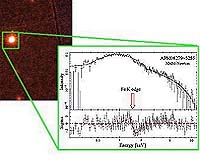
Paris (ESA) Jul 11, 2002 An analysis of 13.5 thousand million-year-old X-rays, captured by ESA's XMM-Newton satellite, has shown that either the Universe may be older than astronomers had thought or that mysterious, undiscovered 'iron factories' litter the early Universe. ESA's Norbert Schartel and colleagues from the Max-Planck-Institut f�r Extraterrestrische Physik,Germany, found more iron than anyone thought possible in the extremely distant celestial object, APM 8279+5255. The object is a quasar, that is, a young galaxy containing an incredibly bright central region, caused by gas falling into a giant black hole. APM 8279+5255 is 13.5 thousand million light years away. Scientists know this because they have estimated a property of its light known as the red shift, which is caused by the expansion of the Universe stretching the wavelengths of light emitted by the celestial object. XMM-Newton's data showed that iron was three times more abundant in the quasar than in our Solar System. Since iron is released by exploding stars, according to precise physical phenomena, and scientists think it builds up across the Universe gradually with time. The Solar System formed just 5 thousand million years ago, so it should contain more iron than the quasar, which formed over 13.5 thousand million years ago. The fact that the quasar contains three times more iron than the Sun is therefore a major puzzle. One possible explanation is that something is wrong with the way astronomers measure the age of objects in the Universe. The almost-holy red shift-distance-age conversion would therefore be wrong. Fred Jansen, ESA's project scientist for XMM-Newton, explains that this would mean rewriting the textbooks. "If you study the evolution of the Universe, one of the basic rules is that we can tie redshift to age. One distinct possibility to explain these observations is that, at the redshift we are looking at, the Universe is older than we think." If the older-Universe interpretation is wrong, there is only one other, stranger possibility, according to Jansen. Somewhere in the early Universe there must be undiscovered 'iron factories', producing the metal by unknown physical means. Understandably, Jansen is cautious about this, saying, "This is the less likely solution in my opinion." If such mysterious objects exist, perhaps XEUS (a next-generation X-ray satellite currently under study by ESA for launch sometime in the next decade) will discover them, because it will have the ability to see the very first galaxies. In the shorter term, ESA is launching INTEGRAL, a gamma-ray- detecting satellite, in October 2002. It will observe exploding stars to study the formation of chemical elements and may explain the anomalous iron observations. The paper containing these results is published on 10 July 2002, in Astrophysical Journal Letters, Vol. 573, L77. The authors were G. Hasinger and S. Komossa at the Max-Planck-Institut f�r Extraterrestrische Physik and N. Schartel at the European Space Agency. Community Email This Article Comment On This Article Related Links XMM-Newton INTEGRAL XEUS SpaceDaily Search SpaceDaily Subscribe To SpaceDaily Express Nuclear Space Technology at Space-Travel.com
 JHU-STScI Team Maps Dark Matter In Startling Detail
 Baltimore MD (SPX) Dec 12, 2005
Clues revealed by the recently sharpened view of the Hubble Space Telescope have allowed astronomers to map the location of invisible "dark matter" in unprecedented detail in two very young galaxy clusters. |
|
|

| The content herein, unless otherwise known to be public domain, are Copyright 1995-2006 - SpaceDaily.AFP and UPI Wire Stories are copyright Agence France-Presse and United Press International. ESA PortalReports are copyright European Space Agency. All NASA sourced material is public domain. Additionalcopyrights may apply in whole or part to other bona fide parties. Advertising does not imply endorsement,agreement or approval of any opinions, statements or information provided by SpaceDaily on any Web page published or hosted by SpaceDaily. Privacy Statement |