|
 |
 |
 |
 |
 |
 |
 |
 |

 |
Is Remote Sensing The Answer To Today's Agriculture Problems
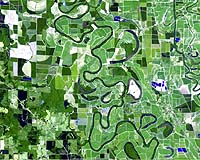
Madison - Jan 16, 2003 Wheat growers turn to aerial imagery to overcome economic, environmental challenges Today's wheat growers face many economic and environmental challenges, but arguably their greatest challenge is the efficient use of fertilizer. Growers need to apply nitrogen-based fertilizer in sufficient quantities to achieve the highest possible crop yields without over-applying - a situation that could lead to serious environmental effects. In wheat, a critical factor comes down to timing in order to determine how efficiently plants will use nitrogen fertilizer. Current methods for determining the optimum timing of nitrogen fertilizer application can be costly, time consuming, and difficult. To assist wheat growers, scientists at North Carolina State University recently developed a technique to properly time nitrogen fertilizer applications. The technique? Remote sensing - a relatively new technology to today's modern agriculture that uses aerial photography and satellite imagery. In this 2000-2001 study, scientists used remote sensing in the form of infrared aerial photographs to determine when early nitrogen fertilizer applications were required. By relating the infrared reflectance of the crop canopy to wheat tiller density, the scientists were able to differentiate wheat fields that would benefit from early nitrogen fertilizer applications compared to wheat fields that would benefit from standard nitrogen fertilizer applications. They tested 978 field locations, representing a wide range of environmental and climatic conditions. The remote sensing technique was found to accurately time nitrogen fertilizer applications 86% of the time across all field locations. The results of this study are published in the January/February 2003 issue of Agronomy Journal. Michael Flowers, project scientist, said, "This is one of the first applications of remote sensing technology for nitrogen management available to growers. With the ability to cover large areas in a quick and efficient manner, this remote sensing technique will assist growers in making difficult nitrogen management decisions that affect profitability and environmental stewardship." These scientists at North Carolina State University and other institutions around the world are continuing to research remote sensing techniques to improve the efficiency of nitrogen fertilizer applications in crops. These techniques will allow growers to more efficiently apply nitrogen fertilizer, increase profitability, and avoid detrimental environmental effects. Community Email This Article Comment On This Article Related Links Agronomy Journal SpaceDaily Search SpaceDaily Subscribe To SpaceDaily Express Earth Observation News - Suppiliers, Technology and Application
 New Legislation Initiated To Support Commercial Remote Sensing Industry
 New York NY (SPX) Jan 11, 2006
The importance of remotely sensed data and technologies to support natural disasters has prompted attention and action in Washington. New initiatives and legislation authorizing appropriations to the remote sensing industry will be discussed at Strategic Research Institute's U.S. Commercial Remote Sensing Industry conference, scheduled for February 9-10, 2006 in Washington D.C. |
|
|

| The content herein, unless otherwise known to be public domain, are Copyright 1995-2006 - SpaceDaily.AFP and UPI Wire Stories are copyright Agence France-Presse and United Press International. ESA PortalReports are copyright European Space Agency. All NASA sourced material is public domain. Additionalcopyrights may apply in whole or part to other bona fide parties. Advertising does not imply endorsement,agreement or approval of any opinions, statements or information provided by SpaceDaily on any Web page published or hosted by SpaceDaily. Privacy Statement |