Energy News  
Is Gusev Crater the site of an ancient Martian lake?.

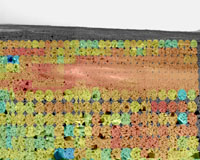
This image shows the martian terrain through the eyes of the Mars Exploration Rover Spirit's mini-thermal emission spectrometer, an instrument that detects the infrared light, or heat, emitted by objects. The different colored circles show a spectrum of soil and rock temperatures, with red representing warmer regions and blue, cooler. A warm and dusty depression similar to the one dubbed Sleepy Hollow stands out to the upper right. Scientists and engineers will use this data to pinpoint features of interest, and to plot a safe course for the rover free of loose dust. The mini-thermal emission spectrometer data are superimposed on an image taken by the rover's panoramic camera. Image credit: NASA/JPL/Arizona State University/Cornell University

Pasadena - Jan 09, 2004
Scientists analyzing data from NASA's Spirit rover to determine water levels at the landing site may not have a final answer for several more weeks, but today they announced that they had uncovered one tantalizing clue.

"We came [to Gusev] looking for carbonates," said Phil Christensen, payload instrument lead for Spirit's mini-thermal emission spectrometer (Mini-TES). "And we have found carbonates." They are present, however, in only trace amounts - 1 to 2 percent of the surface soil.

Mini-TES works in much the same way as a night-vision camera. Unlike human eyes, it "sees" in infrared; it detects heat. Because different minerals radiate heat at slightly different temperatures, an infrared spectrometer like Mini-TES can be used to analyze the mineral content of Mars's rocks and soil.

Mini-TES is a miniature version of TES, the thermal emission spectrometer on onboard Mars Global Surveyor (MGS). The TES science team, which Christensen heads, reported several months ago in the journal Science that they had detected trace amounts of carbonates over large areas of the Martian surface, including in Gusev Crater.

This hard-won finding - the TES team had been trying unsuccessfully for several years to find carbonates on Mars - was confirmed by Mini-TES, which detected a similar carbonate signature in the surface material at Gusev.

Mini-TES did not find evidence of carbonates when it looked at rocks separate from the soil, but because most of the rocks at the Spirit landing site are small and Mini-TES samples a relatively large area at a time, to date the Mini-TES team has been able to acquire data on only a handful of larger rocks.

The carbonates detected, both from orbit and by Spirit, are magnesium carbonates, a group of substances that are typically white and powdery. You probably have some magnesium carbonate in your bathroom at home: it's often used in making toothpaste and cosmetics.

Carbonates require water to form. But, as rover scientists explained today, Spirit could be seeing nothing more than a dusty coating of carbonates, which could have formed through an interaction between water vapor in the atmosphere and rocks on the surface. If this proved true, it would not provide any evidence of the role of water in Gusev's past.


Community
Email This Article
Comment On This Article

Related Links
Mars at JPL
MERs at Cornell
SpaceDaily
Search SpaceDaily
Subscribe To SpaceDaily Express
Mars News and Information at MarsDaily.com
Lunar Dreams and more


Memory Foam Mattress Review
Newsletters :: SpaceDaily :: SpaceWar :: TerraDaily :: Energy Daily
XML Feeds :: Space News :: Earth News :: War News :: Solar Energy News


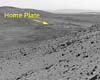
Spirit Heading To 'Home Plate'
Pasadena CA (JPL) Jan 09, 2006
Last week Spirit completed robotic-arm work on "El Dorado." The rover used all three of its spectrometers plus the microscopic imager for readings over the New Year's weekend.


  • Research Generates Reliable Energy Source During Outages
  • Gas Hydrates Offer New Major Energy Source
  • A Hot Time For Cold Superconductors
  • U.Texas At Austin Flywheel Spins To A Milestone Speed Record

  • Yucca Mountain Site Must Make Use Of Geological Safety Net
  • New Jersey Physicist Uncovers New Information About Plutonium
  • Complex Plant Design Goes Virtual To Save Time And Money
  • Volcanic Hazard At Yucca Mountain Greater Than Previously Thought


  • NASA Uses Remotely Piloted Airplane To Monitor Grapes


  • Hewitt Pledges Support For Aerospace Industry
  • National Consortium Picks Aviation Technology Test Site
  • Wright Flyer Takes To The Sky In Las Vegas
  • Aurora Builds Low-speed Wind Tunnel

  • Boeing Selects Leader for Nuclear Space Systems Program
  • Boeing-Led Team to Study Nuclear-Powered Space Systems
  • Boeing To Build Space-borne Power Generator
  • New High-Purity Plutonium Sources Produced At Los Alamos

  • The content herein, unless otherwise known to be public domain, are Copyright 1995-2006 - SpaceDaily.AFP and UPI Wire Stories are copyright Agence France-Presse and United Press International. ESA PortalReports are copyright European Space Agency. All NASA sourced material is public domain. Additionalcopyrights may apply in whole or part to other bona fide parties. Advertising does not imply endorsement,agreement or approval of any opinions, statements or information provided by SpaceDaily on any Web page published or hosted by SpaceDaily. Privacy Statement