
 |
 |
 |
 |
 |
 |
 |
 |
 |

 |
Is Eros A Dusty World
Eros - December 17, 1998 - When the Near Earth Asteroid Rendezvous (NEAR) spacecraft eases into orbit around the asteroid 433-Eros on January 10, dust may be one of its first discoveries. Earlier this year, the Mars Observer spacecraft found that the Red Planet's larger moon, Phobos, is coated with dust up to a meter deep. "That was a surprise," said Dr. James Spann of NASA's Marshall Space Flight Center. "I'm not sure that anyone had an idea of what things look like on these small bodies. I don't imagine that Phobos is so unique that it would have dust and the rest of the small bodies like it won't." Spann is the director of the Dusty Plasmas Laboratory that was established at NASA's Marshall Space Flight Center earlier this year. It was designed to let scientists study the tiniest motes of dust in space-like conditions. Understanding how dust grains interact with each other, and how they react when exposed to sunlight will provide insight into how planets and stars form. The Thermal Emission Spectrometer (TES) instrument on the Mars Global Surveyor observed Phobos, one of the two moons of Mars, on three separate occasions. The primary objective has been to collect infrared spectra, at different wavelengths ranging from ~6 to 50 micrometers, of Phobos to study its composition and physical properties. The TES data indicate that the surface temperature in the shadowed region of Phobos is -170 F (~-112 C), while only several kilometers away on the sunlit side of Phobos the temperature is +25 F (~-4 C). The extreme temperature difference between the night and day sides of Phobos indicates that the surface is composed of very small dust particles that lose their heat rapidly once the Sun has set. In addition, Phobos does not have an atmosphere to help hold heat in during the night. The Mars Global Surveyor did not see the dust directly, but inferred its presence by measuring how quickly Phobos loses its body heat when the sun sets. The rapid loss is best explained by a huge surface area - much greater than if Phobos were a solid, relatively smooth body. A coating of dust would provide the increased surface area - the surfaces of all the miniscule grains added together - to radiate heat into space. This is why, for example, a desert cools so quickly after sunset. So why did dust collect on Phobos, and are Eros and other asteroids also are coated with dust? NEAR, one of NASA's Discovery-class missions, was launched on Feb. 17, 1996, and has already explored one asteroid, 253 Mathilde, in a quick flyby on June 27, 1997. NEAR will rendezvous with 433 Eros on January 10 and settle into an orbit that will be gradually tightened until it lands on the asteroid. Although it does not carry a thermal emission spectrometer like that on the Mars spacecraft, it may return some information about dust on Eros. "It may be that electrostatic forces keep those grains on there," Spann said. Because of the low mass of such bodies, "I don't think that gravity would do it." Spann noted that we tend to think of gravity as the only dominant force in the universe. Indeed, it holds solar systems and galaxies together, and makes leaving this planet an expensive undertaking. But other forces work at smaller scales.
NEAR Reports At SpaceDaily
Asteroid and Other Debris at Spacer.Com
SpaceDev Articles
Email This Article Comment On This Article Related Links Space
 Satellite Launch To Boost DTH In India
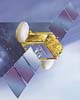 Calcutta, India (SPX) Dec 28, 2005
The successful launch Thursday of India's heaviest satellite from spaceport of Kourou in French Guyana may have boosted the country's space research efforts to yet another level, but it has also lifted the spirits of at least three Direct-To-Home televisions broadcasters, one of which has been waiting for years to launch its services in India. |
|
|

|
|
|
|
|
|
|
|
|
|
|
|
| The content herein, unless otherwise known to be public domain, are Copyright 1995-2006 - SpaceDaily.AFP and UPI Wire Stories are copyright Agence France-Presse and United Press International. ESA PortalReports are copyright European Space Agency. All NASA sourced material is public domain. Additionalcopyrights may apply in whole or part to other bona fide parties. Advertising does not imply endorsement,agreement or approval of any opinions, statements or information provided by SpaceDaily on any Web page published or hosted by SpaceDaily. Privacy Statement |

