
 |
 |
 |
 |
 |
 |
 |
 |
 |

 |
Is Baby Bopp An Only Child
Washington - December 8, 1999 - Comet Hale-Bopp has a moon, says a NASA physicist in California. If confirmed, "Baby Bopp" would be the first satellite ever discovered for a comet, and would allow astronomers to measure a comet's mass for the first time. The claims are made by Zdenek Sekanina of NASA's Jet Propulsion Laboratory. Sekanina developed a mathematical model for the brightness of a comet's nucleus and its coma, the cloud of dust and gas that surrounds the nucleus. He then studied six Hubble Space Telescope digital images of Hale-Bopp's core taken between October 1995 and October 1996, and used his model to strip away the light from the nucleus and coma. In five of the six images, a residual bright area emerged, Sekanina found. He concludes that the bright patch is a satellite about 33 kilometres wide orbiting about 200 kilometres from Hale-Bopp's nucleus. Sekanina thinks observers in Hawaii and Chile, who recorded a speck of light near Hale-Bopp's nucleus on three occasions between September 1996 and January 1998, also glimpsed the moon. "It is perfectly conceivable that this is the same object I was observing," he says. But Harold Weaver, an astrophysicist at Johns Hopkins University who provided the Hubble images Sekanina analysed, is not convinced. Weaver and his colleague Philippe Lamy at the Space Research Laboratory in Marseilles, France, strongly doubt that "Baby Bopp" is real. "We are sceptical, to say the least," says Lamy. Lamy and Weaver believe Sekanina is inferring something from the images that isn't there. "He's just trying to squeeze too much out of the data," says Weaver. He points out that Sekanina analysed the images pixel by pixel, and that a bright point of light falling on several pixels rather than just one can skew the results. Weaver also questions Sekanina's model of the comet's dusty coma. "Hale-Bopp was an extremely dynamic comet, with jets and active regions," he says. "A piece along a jet can be interpreted as another nucleus." Lamy and Weaver also discount the other observations Sekanina cites. Unlike Hubble images, these ground-based observations required mathematical processing to minimise atmospheric distortions. Weaver was using the Hubble telescope to observe Hale-Bopp around the same time. "If that double nucleus was really there, we would have seen it," he says. Brian Marsden, a planetary astronomer at the Harvard-Smithsonian Center for Astrophysics in Cambridge, Massachusetts, is more positive. Many comets have been known to split up, he says, and a comet as large as Hale-Bopp could, in theory, keep a fragment in orbit for some time. Marsden has calculated that 4200 years ago, Hale-Bopp may have passed close enough to Jupiter to break up, as Comet Shoemaker-Levy 9 did before its spectacular crash into Jupiter in 1994. "I like Sekanina's idea, and I tend to believe it," says Marsden. "But it's not an easy type of observation to make, and I'm afraid Sekanina is in the minority." In the minority or not, Sekanina is sure of what he saw. "If there were one image, I wouldn't believe it at all," he says. "With two, I'd still be sceptical. But I found it on five." If any new information confirms that the moon is real, observations of its orbit would reveal Hale-Bopp's mass. Source: Earth, Moon and Planets (vol 77, p 155)
This article will appear in the December 11 issue of New Scientist New Scientist. Copyright 1999 - All rights reserved. The material on this page is provided by New Scientist and may not be published, broadcast, rewritten or redistributed without written authorization from New Scientist.
Related News Baskets at SpaceDaily
Email This Article Comment On This Article Related Links Space
 Satellite Launch To Boost DTH In India
 Calcutta, India (SPX) Dec 28, 2005
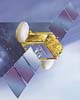
The successful launch Thursday of India's heaviest satellite from spaceport of Kourou in French Guyana may have boosted the country's space research efforts to yet another level, but it has also lifted the spirits of at least three Direct-To-Home televisions broadcasters, one of which has been waiting for years to launch its services in India. |
|
|

|
|
|
|
|
|
|
|
|
|
|
|
| The content herein, unless otherwise known to be public domain, are Copyright 1995-2006 - SpaceDaily.AFP and UPI Wire Stories are copyright Agence France-Presse and United Press International. ESA PortalReports are copyright European Space Agency. All NASA sourced material is public domain. Additionalcopyrights may apply in whole or part to other bona fide parties. Advertising does not imply endorsement,agreement or approval of any opinions, statements or information provided by SpaceDaily on any Web page published or hosted by SpaceDaily. Privacy Statement |


 Cambridge - October 7, 1999 - A group of astronomers led by William Irvine of the University of Massachusetts has discovered that a new molecule, nitrogen sulfide (NS), is contained within comets. Although scientists have long known that the molecule exists within dense interstellar clouds, this is the first time it has been seen in a comet. The findings are being presented during the annual meeting of the Division of Planetary Sciences of the American Astronomical Society, currently underway in Padua, Italy.