|
 |
 |
 |
 |
 |
 |
 |
 |

 |
Irresistible Force Meets Immoveable Object
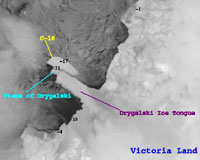
Madison WI (SPX) Mar 30, 2006 During the week of March 20, iceberg C-16 moved rather quickly for a chunk of ice half the size of Wisconsin's Dane County. It followed ocean currents along the Ross Ice Shelf northwestward towards the Drygalski Ice Tongue, remnant of the David Glacier. C-16 is portion of a larger iceberg that broke off in 2000, part of a regular calving schedule that helps the ice shelf maintain its size. Such movements would be lost to glaciologists without satellite imagery. In Wisconsin, meteorologist Shelley Knuth, in the UW-Madison's Antarctic Meteorological Research Center (AMRC), creates images of icebergs daily, sometimes more often, using satellite data. The center has monitored the large tabular icebergs since the current calving period started in 2000. The Drygalski Ice Tongue is roughly the size of Rhode Island. Iceberg C-16 is about half the ice tongue's size. Should the entire tongue break from its hold on the Ross Ice Shelf, it would likely alter the currents along the Scott Coast and in Terra Nova Bay, north of McMurdo Sound, and change the area's climate, according to meteorologist George Weidner, of the UW-Madison's Department of Atmospheric and Oceanic Sciences. It is not certain whether a broken ice tongue would threaten shipping in McMurdo Sound; that depends on how much of the ice tongue breaks off and where the current takes it. UW-Madison collaborated with the University of Chicago to install a weather station and other instrumentation including GPS on both iceberg C-16 and the Drygalski Ice Tongue. Instruments like those are located around the continent and provide vital information about Antarctica's weather. If the ice tongue does break, glaciologists will be able to monitor pressure, temperature and wind changes as it and the iceberg move around, matching those measurements with satellite imagery, and adding to the store of glaciology knowledge. Glaciologist Douglas MacAyeal, professor in the University of Chicago's Department of Geophysical Sciences, notes that last year mega-berg B15-A came dangerously close to whacking the Ice Tongue. C-16, about half the size of B-15A, is coming much closer to damaging the ice tongue, with its coastal approach, rather than the nearly head-on approach B-15A took. MacAyeal reminds us that this "shows how unpredictable various elements of the climate system can be." Weidner notes that, for C-16 to collide with or break the Ice Tongue, the iceberg would need enough momentum to overcome strong Katabatic winds flowing down the David Glacier that would tend to push C-16 to the east. Katabatic winds blow down a topographic incline such as a hill, mountain or glacier, and are prevalent in Antarctica. The ocean currents along the Scott Coast will also likely be deflected to the east along the Drygalski Ice Tongue. For now (March 27), C-16 nestles close to the Drygalski Ice Tongue, cushioned from an impact by sea ice. On March 29, it had knocked off the very tip of the tongue. The AMRC, a unit in the Space Science and Engineering Center, also produces mosaics of Antarctica from satellite data, making them available to researchers and others over the internet. Both AMRC and the AWS receive their funding from the National Science Foundation's Office of Polar Programs. Community Email This Article Comment On This Article Related Links UW-Madison Antarctic Meteorological Research Center University of Chicago Beyond the Ice Age
 Greenlands Glacial Earthquakes Increasing In Frequency
 Ithaca NY (SPX) Mar 24, 2006
Rise of seismic activity linked to the movement of glaciers may be a response to global warming Seismologists at Columbia University and Harvard University have found a new indicator that the Earth is warming: "glacial earthquakes" caused when the rivers of ice lurch unexpectedly and produce temblors as strong as magnitude 5.1 on the moment-magnitude scale. |
|
|

| The content herein, unless otherwise known to be public domain, are Copyright 1995-2006 - SpaceDaily.AFP and UPI Wire Stories are copyright Agence France-Presse and United Press International. ESA PortalReports are copyright European Space Agency. All NASA sourced material is public domain. Additionalcopyrights may apply in whole or part to other bona fide parties. Advertising does not imply endorsement,agreement or approval of any opinions, statements or information provided by SpaceDaily on any Web page published or hosted by SpaceDaily. Privacy Statement |