|
 |
 |
 |
 |
 |
 |
 |
 |

 |
"Iron-Clad" Evidence For Spinning Black Hole
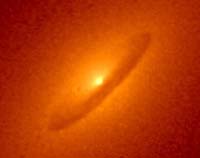
Boston - Sep 17, 2003 Telltale X-rays from iron may reveal if black holes are spinning or not, according to astronomers using NASA's Chandra X-ray Observatory and the European Space Agency's XMM-Newton Observatory. The gas flows and bizarre gravitational effects observed near stellar black holes are similar to those seen around supermassive black holes. Stellar black holes, in effect, are convenient 'scale models' of their much larger cousins. Black holes come in at least two different sizes. Stellar black holes are between five and 20 times the mass of the Sun. At the other end size scale, supermassive black holes contain millions or billions times the mass of our Sun. The Milky Way contains both a supermassive black hole at its center, as well as a number of stellar black holes sprinkled throughout the Galaxy. At a press conference at the "Four Years of Chandra" symposium in Huntsville, Ala., Jon Miller of the Harvard-Smithsonian Center for Astrophysics in Cambridge, Mass. Discussed recent results on the X-ray spectra, or distribution of X-rays with energy, from the iron atoms in gas around three stellar black holes in the Milky Way. "Discovering the high degree of correspondence between stellar and supermassive black holes is a real breakthrough," said Miller. "Because stellar black holes are smaller, everything happens about a million times faster, so they can be used as a test-bed for theories of how spinning black holes affect the space and matter around them." X-rays from a stellar black hole are produced when gas from a nearby companion star is heated to tens of millions of degrees as it swirls toward the black hole. Iron atoms in this gas produce distinctive X-ray signals that can be used to study the orbits of particles around the black hole. For example, the gravity of a black hole can shift the X-rays to lower energies. "The latest work provides the most precise measurements yet of the X-ray spectra for stellar black holes," said Miller. "These data help rule out competing explanations that do not require extreme gravitational effects, and provide the best look yet at the geometry of the space-time around a stellar black hole created by the death of a massive star." The orbit of a particle near a black hole depends on the curvature of space around the black hole, which also depends on how fast the black hole is spinning. A spinning black hole drags space around with it and allows atoms to orbit closer to the black hole than is possible for a non-spinning black hole. The latest Chandra data from Cygnus X-1, the first stellar-size black hole discovered, show that the gravitational effects on the signal from the iron atoms can only be due to relativistic effects, and that some of the atoms no closer than 100 miles to the black hole. There was no evidence that the Cygnus X-1 black hole is spinning. The XMM-Newton data from the black hole, XTE J1650-500, show a very similar distribution of iron atom X-rays with one important exception. More low energy X-rays from iron atoms are observed, an indication that some X-rays are coming from deep in the gravitational well around the black hole, as close as 20 miles to the black hole event horizon. This black hole must be spinning rapidly. Chandra observations of a third stellar black hole, GX 339-4, have revealed that it is also spinning rapidly, and clouds of warm absorbing gas appear to be flowing away from the black hole at speeds of about three hundred thousand miles per hour. Such warm gas flows have been observed in the vicinity of supermassive black holes. Previous observations of some supermassive black holes by Japan's ASCA satellite, XMM-Newton and Chandra have indicated that they may also be rotating rapidly. The latest results presented by Miller indicate that the peculiar geometry of space around spinning stellar-mass black holes and supermassive black holes is remarkably similar. Stellar and supermassive black holes may be similar in other ways. Powerful jets of high-energy particles have been detected around both types of black holes. Why do some stellar black holes spin rapidly and others not? One possibility is that differences in spin are imparted at birth when a massive star collapses. Another possibility is that the spin rate depends on how long the black hole has been devouring matter from its companion star, a process that makes the black hole spin faster. Black holes with more rapid spin, XTE J1650-500 and GX 339-4, have low-mass companion stars. These relatively long-lived stars may have been feeding the black hole for longer, allowing it to spin up to faster rates. Cygnus X-1 with its short-lived companion star may not have not time to spin up. Community Email This Article Comment On This Article Related Links Chandra at Harvard Chandra at NASA SpaceDaily Search SpaceDaily Subscribe To SpaceDaily Express Black Hole Science and News
 MIT: SpInning Black Hole Leaves Dent In Space-Time
 Boston MA (SPX) Jan 12, 2006
MIT scientists and colleagues have found a black hole that has chiseled a remarkably stable indentation in the fabric of space and time, like a dimple in one's favorite spot on the sofa. |
|
|

| The content herein, unless otherwise known to be public domain, are Copyright 1995-2006 - SpaceDaily.AFP and UPI Wire Stories are copyright Agence France-Presse and United Press International. ESA PortalReports are copyright European Space Agency. All NASA sourced material is public domain. Additionalcopyrights may apply in whole or part to other bona fide parties. Advertising does not imply endorsement,agreement or approval of any opinions, statements or information provided by SpaceDaily on any Web page published or hosted by SpaceDaily. Privacy Statement |