|
 |
 |
 |
 |
 |
 |
 |
 |

 |
Iraqi Prime Minister Surprised Friends And Foes
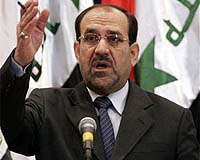
RIA Novosti political commentator Moscow (RIA Novosti) Aug 29, 2007 Iraqi Prime Minister Nouri al-Maliki made a serious step towards national unity at a time when Paris and Washington showered him with criticism. At a news conference in Baghdad on August 26, he announced that at a joint meeting representatives of the Iraqi Sunnis, Shiites and Kurds had reached agreement on a number of issues, which were crucial for the restoration of political stability, such as amnesty of political prisoners, elections to local and provincial governments, a bill on redistribution of oil profits and, last but not the least, abolition of the ban on jobs for the former Baath party members. Disputes over these issues paralyzed the Iraqi government for six months and prompted six ministers from the Sunni Iraqi Accord Front to boycott it. Now the Iraqis have a chance of getting out of the political deadlock. Although the ministers are not rushing to resume their duties, they and the Sunnis in general are not averse to dialogue with other ethnic and religious groups. All this happened several days after U.S. Ambassador to Iraq Ryan Crocker expressed his strong disappointment with political developments in Iraq, and Democratic U.S. senators, Carl Levin and Hillary Clinton, declared that al-Maliki had to resign. French Foreign Minister Bernard Kouchner made the same conclusion after his trip to Baghdad. Only U.S. President George W. Bush supported the Iraqi prime minister, urging his government to step up its efforts. The Sunni-Shiite-Kurd agreement justifies the U.S. president's trust in Nouri al-Maliki. The prime minister is by no means an American yes-man. To the contrary, Washington is displeased with his trips to Tehran and Damascus. Moreover, after the Iraqi parliamentary elections in December 2005, the United States has largely lost an opportunity to keep the domestic situation in Iraq under its tough control. Although Iraq is subjected to different external influences, it is already following its own logic of development in many respects. Nouri al-Maliki was appointed to his current position following months of debates among Iraqi policymakers. There were no other compromise nominees who would suit the majority of Iraqi MPs, and Washington is bound to remember that. Besides, any other politician would have to deal with the same problems. Any government reshuffle will obstruct political settlement for the indefinite time. The American president cannot allow this to happen. As distinct from Levin and Clinton, he has no time for political experiments. This is why he has backed al-Maliki. The opposition senators' opinion about the Iraqi government's inability to rule the country is largely supported by U.S. intelligence reports and by the French foreign minister who quoted his Iraqi sources. Whether we agree to it or not, this will not change the Iraqi situation. The Europeans have been removed from the local events for too long and the Americans have made too many mistakes there. It is up to the Iraqis now whether to trust al-Maliki or not. Iraq continues to depend on the West and on its neighbors; different countries have conflicting interests on its territory; it still has to come a long way to political stability and security. But today Iraq has retrieved its sovereignty, at least in words. (De jure, it did this in 2004, and de facto it has not done it up to this day). This is how we should interpret al-Maliki's criticism of the U.S. senators who "talk about Iraq as if Iraq is their property," without any respect for its sovereignty. He also demanded apologies from the French foreign minister. Time will show whether al-Maliki's government will make it or not. Achieving national unity is not an easy task, but it is obvious that Iraq and the Iraqis are gaining self-confidence. The opinions expressed in this article are the author's and do not necessarily represent those of RIA Novosti.
Source: RIA Novosti Community Email This Article Comment On This Article Related Links Iraq: The first technology war of the 21st century
 The Real Analogy For Iraq
 Washington (UPI) Aug 24, 2007
 The conflict raging in Iraq has been compared to many earlier wars, but the best historical comparison has been largely overlooked. Identifying the right analog is important, because it can help U.S. government and military leaders anticipate what may come next in Iraq and make better judgments about what actions to take. |
|
|

| The content herein, unless otherwise known to be public domain, are Copyright 1995-2007 - SpaceDaily.AFP and UPI Wire Stories are copyright Agence France-Presse and United Press International. ESA Portal Reports are copyright European Space Agency. All NASA sourced material is public domain. Additional copyrights may apply in whole or part to other bona fide parties. Advertising does not imply endorsement,agreement or approval of any opinions, statements or information provided by SpaceDaily on any Web page published or hosted by SpaceDaily. Privacy Statement |