|
 |
 |
 |
 |
 |
 |
 |
 |

 |
Iraq War See Widespread Use Of Unmanned Air Vehicles
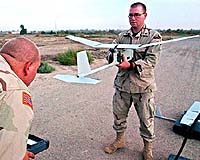
Fob Warhorse, Iraq (UPI) Jan 22, 2008 The use of unmanned aerial vehicles to help snoop out enemy movements, uncover large caches of explosives and give U.S. commanders a 24/7 real-time view of their battlespace has come into its own in Iraq's counter-insurgency battle. The best-known UAV to the public is the Predator, which cut its teeth in the Balkans. Its variable-aperture camera can see through smoke and dust, while its infrared camera turns night into day. Earlier in the conflict in both Iraq and Afghanistan, lethality was added to the vehicle's capability by attaching two laser-guided Hellfire anti-tank missiles to its wings that can be launched by an on-the-ground control team that "pilots" the Predator and controls its sensors and weapons. With an empty weight of 1,300 pounds, length of 27 feet and a wingspan of almost 49 feet, the bird -- powered by a 101 horsepower engine -- is the big boy on the block, able to cruise as high as 25,000 feet. Less well-known, but just as valuable, are the smaller Shadow 200s and Ravens. "They haven't been able to arm it (the Shadow) yet because of the weight, but we do a lot of coordination with the air weapons teams, the Apaches (attack helicopters)," Lt. Jason Siler said of the Shadow. "We're kind of the hunter and they're the killers." Siler is with Delta Troop, 2nd Squadron, 1st Cavalry Regiment, attached to 4th Stryker Brigade Combat Team of the Army's 2nd Infantry Division. The unit is responsible for four Shadow UAVs that fly from Forward Operating Base Normandy in Baqubah, Diyala province. At least one of the unit's four aircraft -- which only perform reconnaissance, surveillance and intelligence-gathering tasks -- is in the air 24/7 to give the brigade a constant flow of real-time information and pictures of activity in their sector, whether it be movements of an al-Qaida group, suspect vehicles, blocked roads or a bird's-eye or closer view of terrain. Each Shadow is aloft for about six hours, depending on fuel consumption. Each carries a digitally enhanced electro-optic camera with infrared capability that transmits images to the ground control station and can be relayed to other receivers. The camera can rotate 360 degrees. A 38-horsepower, gasoline engine powers the bird, which generally cruises at a speed of 50-60 knots and at an altitude as low as 500 feet or less when needed. In terms of weight and dimensions, the tactical UAV launched by a hydraulic catapult weighs just 375 pounds and has a 14-foot wingspan. Delta Troop's flight command center is a container unit on the back of a Humvee. Two men sit side-by-side in the unit -- one flying the UAV and the other operating its package of cameras and sensors. "We're not rated as pilots," Sgt. Thomas Oberman of Portsmouth, Va., said as he controlled a UAV in flight. "We have no illusions about that, but we're well-versed in air operations, weather, everything that comes into getting the bird up and on mission." Oberman said the two men working the Shadow's joy stick and mission package switch off at the four-hour point, when attention to small details on their respective screens may start to wane. "Yeah," added Cpl. Andrew Currier, from Missoula, Mont. "You kinda go crazy looking at the same thing so we switch off to go crazy looking at something else." The Shadow serves a brigade. For smaller units in the field there is the Raven. It's just 4.5 pounds, 38 inches long and has a 5-foot wingspan. It comes in sections that fit into a single suitcase, a handheld controller and small image receiver that fits easily into a backpack. It's launched manually, much like the paper airplanes kids play with, but with a running start. The Raven, with a small electric engine and camera, can stay aloft for an hour. Its optics aren't as sophisticated as the Shadow or Predator but are good enough to give its operator a good, clear image of a man carrying a rifle while flying at a height of 1,000 feet. Like the Shadow, it's gray in color and hard to see when in flight. Up close, the Raven in flight sounds like a loud bumble bee. Aerial systems for real-time battlefield observation were first used in the battle of Fleurus in 1794, when the French put a manned balloon aloft to scout Austrian troop movements. Balloons were used regularly during the American Civil War. Now unmanned systems are in the fore, and research shows more developments in miniaturization are possibly on the way. The Defense Department and civilian industry are said to be working on a UAV the size of a human hand for use by small units in an urban environment. Community Email This Article Comment On This Article Related Links UAV News - Suppliers and Technology
 BAE Systems Delivers UAV Target Detection Systems To US Army
 Washington DC (SPX) Jan 18, 2008
BAE Systems has delivered five target detection systems to the U.S. Army for use on Shadow unmanned aerial vehicles (UAV). The AURORA Generation IV remote sensing system will provide U.S. forces with precise detection and identification of potential threats, increasing mission capability and survivability. |
|
|

| The content herein, unless otherwise known to be public domain, are Copyright 1995-2007 - SpaceDaily.AFP and UPI Wire Stories are copyright Agence France-Presse and United Press International. ESA Portal Reports are copyright European Space Agency. All NASA sourced material is public domain. Additional copyrights may apply in whole or part to other bona fide parties. Advertising does not imply endorsement,agreement or approval of any opinions, statements or information provided by SpaceDaily on any Web page published or hosted by SpaceDaily. Privacy Statement |