|
 |
 |
 |
 |
 |
 |
 |
 |

 |
Iran and IAEA discuss on nuclear questions
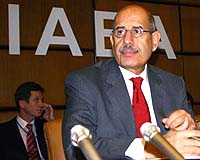
Tehran (AFP) Oct 9, 2007 Iran and a delegation from the UN nuclear watchdog held talks on Tuesday about Tehran's controversial uranium enrichment programme, the Isna news agency reported, but there were no details on what was discussed. "The first day of talks has ended, and negotiations will resume tomorrow," Isna said. The Iranian team was being led by Javad Vaidi, deputy to Ali Larijani, Tehran's chief nuclear negotiator. Olli Heinonen, the International Atomic Energy Agency's deputy director general for safeguards, is leading the IAEA delegation in the discussions, which are expected to last two or three days. The IAEA is seeking details on how Iran obtained components for its P1 type centrifuges, of which more than 2,000 are in operation at its nuclear enrichment plant at Natanz, and on its research with the more efficient P2 model. The new talks follow an agreement reached in August for Tehran to provide answers to outstanding questions over its nuclear programme including plutonium experiments. According to the Iran-IAEA agreement, the round of talks that opened on Tuesday should be the second and last in which Tehran was to reply in writing to IAEA questions before a meeting in mid-October at which Iran's answers can be clarified. But according to informed sources quoted by Iran's official news agency IRNA, Tehran this week will reply to "questions from the agency and the technical delegation (led by Heinonen) and take notes to transmit to the IAEA. "Then during a meeting in mid-October, Iran's responses to the IAEA will be finalised and, if the agency has new points to raise on these replies, it will present them," according to the source quoted by IRNA. Much of the West, headed by the United States, charge that Tehran is working secretly to obtain nuclear weapons. Iran strongly denies this, saying its work is to achieve nuclear power to generate electricity, to which it has the right. IAEA director Mohammed ElBaradei recently urged Iran to cooperate actively on answering the outstanding questions, warning it that failure would leave it open to renewed pressure. Tehran has been slapped with two sets of UN sanctions for refusing to freeze uranium enrichment, a process that creates nuclear fuel but can also make the core of an atomic bomb. The IAEA and EU foreign policy chief Javier Solana are due to report to the UN Security Council next month on Iran's willingness to give up enrichment in exchange for political and trade incentives. Tehran consistently refuses to give up enrichment. The major powers, split over whether to impose further sanctions, have said they they will await the reports before deciding what action to take. Community Email This Article Comment On This Article Related Links Learn about nuclear weapons doctrine and defense at SpaceWar.com Learn about missile defense at SpaceWar.com All about missiles at SpaceWar.com Learn about the Superpowers of the 21st Century at SpaceWar.com
 Israel's Syria strike 'not signal for Iran': parliamentary speaker
 Geneva (AFP) Oct 9, 2007
Israel's air strike inside Syrian territory in early September was not a message for Iran despite claims by some US conservatives, Iran's parliamentary speaker said on Tuesday. |
|
|

| The content herein, unless otherwise known to be public domain, are Copyright 1995-2007 - SpaceDaily.AFP and UPI Wire Stories are copyright Agence France-Presse and United Press International. ESA Portal Reports are copyright European Space Agency. All NASA sourced material is public domain. Additional copyrights may apply in whole or part to other bona fide parties. Advertising does not imply endorsement,agreement or approval of any opinions, statements or information provided by SpaceDaily on any Web page published or hosted by SpaceDaily. Privacy Statement |