|
 |
 |
 |
 |
 |
 |
 |
 |

 |
Iran Working On Secret Missile Programs: Opposition Group
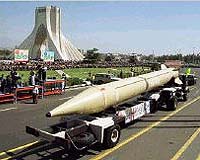
London, UK (AFP) Dec 02, 2004 Iran is developing new medium- and long-range missiles which can reach Western Europe and target US-led forces in Iraq, an Iranian opposition group claimed Thursday. The National Council of Resistance of Iran (NCRI) said the new long-range missiles, the Ghadr and Shahab-4, had a planned range of 3,000 kilometers (1,900 miles) which would allow them to reach as far as Berlin. It also said an upgraded version of the Zelzal missile could hit targets as far as 300 kilometers (190 miles) away with minute precision and was specifically designed for "offensive use" in foreign countries, notably against US-led multinational forces in Iraq. One NCRI source, speaking anonymously, said North Korean and Chinese scientists were "definitely" helping the Iranian missile programs. The NCRI, the political branch of the main Iranian armed opposition group the Mujahedeen-e-Khalq (MEK), or People's Mujahedeen, acknowledged that none of the missile programs it described actually contravened any international weapons agreement signed by Tehran. But if Iran could produce missiles with a capacity to carry nuclear and chemical warheads it would "represent an endgame" for the Islamic regime, Ali Safavi of the NCRI said. "Had Hitler been able to acquire a nuclear bomb... the entire situation at that time would have changed with respect to peace and security in the world. And in that sense, I think that the danger and the threat posed by the Iranian regime is no less than that," Safavi told a press conference in London. The NCRI and People's Mujahadeen are listed as terrorist organizations in the United States, and have a mixed record for exposing clandestine activities within Iran. But they have been instrumental in unveiling Iranian nuclear activities, most recently alleging that a site near Tehran is a secret nuclear bomb facility. Citing a leaked report from Iran's Revolutionary Guard Air Force and unnamed sources within the regime, Safavi provided detailed descriptions of the capacity of the Ghadr, Shahab-4 and Zelzal-2 missiles, as well as of an alleged top-secret missile storage site. The Ghadr, he said, was an improved version of the Shahab-3, a ballistic missile believed to be based on a North Korean design that can reach Israel. The Shahab-4 has greater precision than the Shahab-3 and, like the Ghrab, has a range of up to 3,000 kilometers depending on payload, he added. Safavi described the Zelzal-2 as a "very, very precise missile" due to its non-directional beacon frequency system (NDB), a guiding system, and said it was designed by Iran's mullahs with the US forces in mind. He quoted the leaked Iranian air force report saying the Zelzal-2 "has been produced for deploying in other countries and in Iraq in particular." It was designed "with particular attention to the military forces, specifically coalition forces in Iraq", Safavi added. The anonymous NCRI source said Chinese and North Korean authorities had few fears about potential reprisals from Western powers if they supported Iran's missile programs because, like Tehran, they sensed a "lack of resolve" to deal with the regime's potential threat. "There's no question that Iranians have enjoyed the support of the North Koreans and the Chinese in their missile program," the source said. The NCRI also claimed the Iranian regime was working to create nuclear and chemical warheads for the missiles and had "made enormous efforts in this field". But Safavi, who also heads a Washington-based consulting group, Near East Policy Research Inc., provided no proof for the claims aside from naming the alleged head of the nuclear work and its alleged production site. All rights reserved. � 2004 Agence France-Presse. Sections of the information displayed on this page (dispatches, photographs, logos) are protected by intellectual property rights owned by Agence France-Presse. As a consequence, you may not copy, reproduce, modify, transmit, publish, display or in any way commercially exploit any of the content of this section without the prior written consent of Agence France-Presse. Community Email This Article Comment On This Article Related Links SpaceDaily Search SpaceDaily Subscribe To SpaceDaily Express Learn about missile defense at SpaceWar.com All about missiles at SpaceWar.com
 Northrop Grumman Wins Contract For Target And Space-Launch Missile Work
 Reston VA (SPX) Jan 12, 2006
Northrop Grumman has been awarded a follow-on contract to provide technical support to the U.S. Air Force's Rocket Systems Launch Program (RSLP). |
|
|

| The content herein, unless otherwise known to be public domain, are Copyright 1995-2006 - SpaceDaily.AFP and UPI Wire Stories are copyright Agence France-Presse and United Press International. ESA PortalReports are copyright European Space Agency. All NASA sourced material is public domain. Additionalcopyrights may apply in whole or part to other bona fide parties. Advertising does not imply endorsement,agreement or approval of any opinions, statements or information provided by SpaceDaily on any Web page published or hosted by SpaceDaily. Privacy Statement |