|
 |
 |
 |
 |
 |
 |
 |
 |

 |
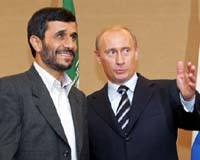
Iran Undermines Russia
UPI Outside View Commentator Moscow (UPI) Jun 28, 2006 The Iranian leader has again turned the tables, or rather the table of the G8 July summit in St. Petersburg. On June 29, the G8 foreign ministers will meet in Moscow to discuss primarily the Iranian issue. President Mahmoud Ahmadinejad said Tehran would give the answer to the offer made by Russia, the United States, China, Britain, France and Germany -- the Five-Plus-One states -- not by June 29, as the European Union, China and Russia hoped and the United States demanded, but in late August. The Iranian leader made this statement in an address to his voters in Hamadan, a city in western Iran, which has strengthened his standing in his home country. At the June 29 meeting Moscow in ministers will determine if there are enough reasons to resume talks, or the Iranian nuclear dossier should be left to the United Nations Security Council. The foreign ministers must know Tehran's stand on the Five-Plus-One offer to make a decision on keeping the dossier in the UN or returning it to the International Atomic Energy Agency. Their decision is to be signed by the G8 leaders. During their meeting in Vienna on June 1, the foreign ministers of the six states approved a package of offers designed to convince Iran to stop uranium enrichment. The six countries thought their offer was quite attractive to Iran, and hoped its acceptance would help resume talks. What stands behind Ahmadinejad's statement? Surely not only the "heaps of ambiguities" in the offer, as Foreign Minister Manouchehr Mottaki said in Italy. Tehran is most likely dissatisfied with the provision on freezing enrichment as an obligatory condition for resuming talks. The Iranian authorities said that the provision distorted the essence of the forthcoming talks. In fact, it needs the talks primarily to discuss freezing uranium enrichment in response to western concessions. It appears that Tehran's announcement was a response to the statement by President George W. Bush, who promised Iran "progressively stronger political and economic sanctions" if Tehran refused to verifiably suspend its uranium enrichment program. It may also be that Moscow had unwittingly prompted Tehran's negative decision. Russia's First Deputy Foreign Minister Andrei Denisov, who led the Russian delegation to the session of the foreign ministers of the Organization of the Islamic Conference in Baku, Azerbaijan, said Russia would not support UN Security Council decisions sanctioning the use of military force against Iran. The same day, Russian president's aide Igor Shuvalov told journalists Russia would also insist on the inadmissibility of economic sanctions against Iran even if its stand clashed with the position of the other participants in the G8 summit in St. Petersburg. If this supposition is correct, it means that Tehran has again let Russia down. Tehran most likely used the complicated Washington-EU relations over Iran -- the White House wants Europe's undivided support over the Iranian nuclear fuel issue -- to force its rules of the game on the partners. And yet, why did the Tehran authorities come to this decision, especially if their initial reaction to the Five-Plus-One offer was positive? Some newspapers claim that Iran's spiritual leader Ayatollah Ali Khamenei was initially against the six countries' offer, which he described as "weak and disappointing." Tehran may again use the tactic which Khamenei calls "subtle diplomacy," the art of acting in international relations in such a way as to protect and strengthen national interests to the utmost level, as Iranian journalist Parviz Esmaeili put it. On the other hand, many analysts say Iran's political establishment was divided over the nuclear fuel program and the six countries' offer. The majority would like to accept the right to limited enrichment, but this group does not include Ayatollah Khamenei or President Ahmadinejad, who reject all and any restrictions. If this is true, this imbalance in the Iranian leadership is the main reason for postponing the answer until the end of August. The world can wait for another "moment of truth" regarding Iran, but will Iran benefit or suffer from the delay? Events can now take any turn, including some that will run counter to the Russian and Chinese opinion. (Pyotr Goncharov is a political commentator for the RIA Novosti news agency. This article is reprinted by permission of RIA Novosti.) (United Press International's "Outside View" commentaries are written by outside contributors who specialize in a variety of important issues. The views expressed do not necessarily reflect those of United Press International. In the interests of creating an open forum, original submissions are invited.)
Source: United Press International Community Email This Article Comment On This Article Related Links Learn about nuclear weapons doctrine and defense at SpaceWar.com Learn about nuclear weapons doctrine and defense at SpaceWar.com Learn about missile defense at SpaceWar.com All about missiles at SpaceWar.com Learn about the Superpowers of the 21st Century at SpaceWar.com
 Iran Says No Use Negotiating With US
 Tehran (AFP) Jun 27, 2006
Iran's supreme leader Ayatollah Ali Khamenei said Tuesday he saw "no use" in negotiating with the United States and again signalled that Tehran was unwilling to freeze sensitive nuclear work. |
|
|

| The content herein, unless otherwise known to be public domain, are Copyright 1995-2006 - SpaceDaily.AFP and UPI Wire Stories are copyright Agence France-Presse and United Press International. ESA PortalReports are copyright European Space Agency. All NASA sourced material is public domain. Additionalcopyrights may apply in whole or part to other bona fide parties. Advertising does not imply endorsement,agreement or approval of any opinions, statements or information provided by SpaceDaily on any Web page published or hosted by SpaceDaily. Privacy Statement |