|
 |
 |
 |
 |
 |
 |
 |
 |

 |
Iran, Russia agree to continue nuclear talks
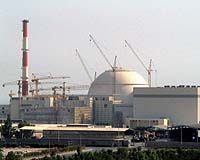
Tehran (AFP) May 28, 2006 Russia and Iran wrapped up high-level talks on the Islamic republic's nuclear programme on Sunday, with Tehran saying both sides agreed to continue negotiations and work towards a peaceful solution to the crisis. But the country's supreme leader Ayatollah Ali Khamenei continued to rule out any climbdown in the dispute, centred around Western fears the clerical regime could acquire nuclear weapons under the guise of an atomic energy drive. "The two delegations insisted on a peaceful and diplomatic solution to the Iranian nuclear question," the ISNA student news agency quoted a statement from Iran's Supreme National Security Council as saying. "The two parties agreed to continue their discussions," it added. Russian National Security Council chief Igor Ivanov and Deputy Foreign Minister Sergei Kislyak held a series of meetings with top Iranian officials -- led by Ali Larijani, Tehran's top negotiator -- in talks lasting more than five hours. The Russian mission followed Wednesday's meeting of senior officials from Britain, China, France, Russia and the United States -- the five permanent UN Security Council members -- and Germany. The major powers discussed a European proposal aimed at breaking Iran's determination to enrich uranium, a process which can be extended from making reactor fuel to nuclear weapons. The EU proposal would combine technology, economic and other incentives for Iran, but also the threat of an arms embargo and other sanctions if the Islamic republic defied a UN injunction to halt enrichment. Tehran has rebuffed the EU proposal, repeating that its right to enrich uranium was not negotiable. A follow-up meeting at foreign ministers level is expected in the coming week. US officials said it would probably take place in a European capital. The Russian delegation was to leave Tehran later Sunday, and a source close to the Iranian delegation told AFP that more talks with Russia would likely take place after the foreign ministers meeting. Despite the intensive talks with Russia, Khamenei signalled that Iran was still in no mood to back down on enrichment. "The young Iranian engineers, with their successes, have guaranteed the long-term energy future of the country," the top cleric said of Iran's progress in nuclear fuel cycle work. "We must not lose this at any price, because any retreat would be a 100 percent loss," Khamenei was quoted as saying by state television. Both Russia and China oppose talk of sanctions against Iran. Russia in particular has huge economic interests in Iran's atomic energy drive, and is helping build its first nuclear reactor in Bushehr. Last year Russia offered to produce nuclear fuel on Iran's behalf in order to ease fears Tehran would divert uranium into warheads. Talks broke down when Iran insisted uranium enrichment had to be carried out on its soil. As a signatory to the nuclear Non-Proliferation Treaty (NPT), Iran insists it has a right to uranium enrichment and has vowed not to back down on nuclear research and development. "The Islamic Republic of Iran remains firm in its position, to use nuclear technology in a peaceful and legal framework," hardline President Mahmoud Ahmadinejad was quoted as saying in newspapers on Sunday. "The position of Iran concerning the nuclear issue is totally legal and in the framework of the NPT," he said. But there have been some signs of a compromise. Iran's ambassador to the United Nations, Javad Zarif, said Friday that Tehran was willing to accept a cap on its uranium enrichment capability to ensure the fuel produced is not used to develop nuclear weapons. And the New York Times reported Saturday that President George W. Bush's administration was beginning to debate whether to set aside a longstanding boycott of Iran and open direct talks to try to resolve the crisis. The United States severed relations with Iran after the 1979 Islamic revolution and the crisis over the seizure of American hostages, and Bush in 2002 famously described Tehran as part of an "axis of evil". Community Email This Article Comment On This Article Related Links Learn about nuclear weapons doctrine and defense at SpaceWar.com Learn about missile defense at SpaceWar.com All about missiles at SpaceWar.com Learn about the Superpowers of the 21st Century at SpaceWar.com
 US, allies hold WMD-seizing drills in Mediterranean
 Mediterranean, Turkey (AFP) May 26, 2006
 Air and naval forces from the United States, Turkey, France and Portugal "seized" a ship carrying mock weapons of mass destruction in drills Friday which Turkey has denied are aimed at neighboring Iran. |
|
|

| The content herein, unless otherwise known to be public domain, are Copyright 1995-2006 - SpaceDaily.AFP and UPI Wire Stories are copyright Agence France-Presse and United Press International. ESA PortalReports are copyright European Space Agency. All NASA sourced material is public domain. Additionalcopyrights may apply in whole or part to other bona fide parties. Advertising does not imply endorsement,agreement or approval of any opinions, statements or information provided by SpaceDaily on any Web page published or hosted by SpaceDaily. Privacy Statement |