|
 |
 |
 |
 |
 |
 |
 |
 |

 |
Iran Opposition Wants Sanctions
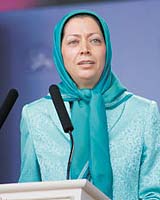
UPI International Editor Washington (UPI) Jun 28, 2006 It was hard not to miss the irony of meeting in a restaurant called "Cafe de la Paix" while discussing revolutions, mass executions, terrorism and regime change with two Iranian dissident leaders who belong to a group accused of terrorism by the United States and the European Union. The Mojahedeen-e-Khalq, or the people's mujahedeen (holy warriors), stand accused of terrorism, of being Marxist-Islamists, and of being a secretive sect which brainwashes its members. The group rejects these accusations. They explain that the Marxist label was placed on them by the shah, when many members of the resistance were still in university and -- as was frequently the case in the 1950s and 1960s -- a good number of students were leaning to the left and flirting with communism. The shah, the MeK say, applied the Marxist label because it helped isolate their movement and allowed for their persecution; when the Islamic revolution swept Ayatollah Ruhollah Khomeini to power, it also suited him to keep that label on the MeK. Maryam Rajavi, the charismatic leader of the Iranian opposition, the National Council of Resistance of Iran, an umbrella group encompassing the MeK, and her followers describe themselves as "a movement that is a deeply democratic force, Muslim and freedom-loving. "We believe in social freedom and are deeply opposed to Islamic fundamentalism," Rajavi told United Press International during an interview at her home in the French town of Auvers-sur-Oise, June 25 week. She describes her movement as the antithesis to Islamic fundamentalism. But a European official who spoke to United Press International on condition of anonymity, said that one could not ignore "the terrorist nature of this group, whose activities as a terrorist organization are well-known." According to the National Memorial Institute for the Prevention of Terrorism -- MIPT -- the group conducted a number of attacks on U.S. military personnel and civilians in Iran in the 1970s. Although the group initially supported the 1979 revolution and the overthrow of the shah, the group's secular perspective led to an eventual crackdown by the Khomeni regime. Thousands of MeK members were killed and imprisoned during the repression. The MeK's leaders fled to Paris and their military infrastructure moved to Iraq. In 1991, it assisted Saddam Hussein in suppressing the Shiite and Kurdish uprisings, and continued to perform internal security services for the government. The MeK's goal is to overthrow the Iranian government and replace it with the NCRI. At a 1995 conference, the group outlined a 16-point plan which included freedom of belief, expression and the press, without censorship; freedom for political parties, unions, etc.; ensure governments would be elected; Respect for the Universal Declaration of Human Rights; Periodically, the MeK have released information on Iran's developing nuclear weapons program. In their campaign against the theocratic regime in Tehran, the group -- according to the U.S. Naval Postgraduate School and other sources -- "stresses propaganda and occasionally uses terrorism." Leaders of the MeK deny killing Americans. According to SITE Institute (The Search for International Terrorist Entities) in 1981 the MeK detonated bombs in the head office of the Islamic Republic Party and the premier's office, killing some 70 high-ranking Iranian officials, including Chief Justice Ayatollah Mohammad Beheshti, President Mohammad-Ali Rajaei, and Premier Mohammad-Javad Bahonar. "This was an attack the MeK claimed responsibility for," said a European official. High-ranking officials of the MeK insist that they are fighting a war of liberation and that attacks against the regime in Tehran are legitimate. But perhaps the single-most important event that blemished their standing in the eyes of many Iranians was the fact that towards the end of the eight-year Iran-Iraq war (1980-1988), the MeK allowed Baghdad to arm them with heavy weapons and send them into battle against Iranian forces. Mohammad Mohaddesin, who holds the title of chairman of the Foreign Affairs Committee in the NCRI, told UPI that Iranian troops were pleased to see them and that many joined their ranks. In April 1992, the MeK conducted near-simultaneous attacks on Iranian embassies and installations in 13 countries, demonstrating the group's ability to mount large-scale operations outside Iran. Then in April 1999, the MeK targeted key military officers and assassinated the deputy chief of the Iranian Armed Forces General Staff. In February 2000, the group launched a dozen attacks against Iran, including a mortar attack against the leadership complex in Tehran where the offices of the supreme leader and the president were situated. Terrorist attacks by the MeK declined in 2000 and 2001. When U.S. forces entered Iraq in 2003, the MeK was ordered not to resist Coalition forces. The MeK leadership and the U.S. signed a formal cease-fire arrangement in May 2003. Maryam Rajavi and her supporters disputes the terrorist claims, justifying them by saying that they were legitimate attacks on military targets. Ali Safavi, head of the Foreign Affairs Committee in the NCRI, said that the group "ceased all military operations in July 2001." Additionally, said Safavi, "The MeK never targeted civilians." The group has been lobbying hard to be taken off the terror list. When asked why they think they are still on it, Safavi replies: "Because (U.S. Secretary of State) Condoleezza Rice refuses to push the delete button." In an exclusive interview with UPI, Maryam Rajavi said: "Being on the terror list is the result of a policy of appeasement of the mullahs' regime by Western governments. That policy has totally failed." Rajavi added: "These concessions have emboldened the mullahs' regime. It made them further their rogue behavior. This is the result of the policies of Western governments. There is no will in the West to stand up against their behavior and so they continue to blackmail and make threats and impose their demands on the international community. "That's how they perceive it. And that is a major political miscalculation by the West. The mullahs are incapable of reform. They are taking advantage of mistakes the West is making. So imagine the day when the mullahs have nuclear weapons." Raymond Tanter, a former member of the Reagan National Security Council who is campaigning to have the MeK removed from the U.S. terror list, says the MeK are the only opposition group inside and outside Iran organized enough to be in a position to seriously challenge the current government. But, says a European official who has served in Iran, "The MeK is highly despised inside Iran." Asked if the MeK might consider an alliance with the shah's son -- and heir to the Peacock Throne -- Reza Pahlavi, Rajavi replied: "Monarchy is something that belongs to the past." For his part, Ali Safavi believes that "Pahlavi's fame is only due to his father's infamy." "Impose diplomatic, economic, oil sanctions. Isolate the mullahs. Do something that shows the mullahs the decisiveness of the United States and the Western countries," Rajavi asks of President Bush. "And immediately after that, recognize the Iranian resistance and the people of Iran. The rest of it the resistance can do it themselves."
Source: United Press International Community Email This Article Comment On This Article Related Links Learn about nuclear weapons doctrine and defense at SpaceWar.com Learn about nuclear weapons doctrine and defense at SpaceWar.com Learn about missile defense at SpaceWar.com All about missiles at SpaceWar.com Learn about the Superpowers of the 21st Century at SpaceWar.com
 Japan And Canada Urge North Korea To Give Up Nuclear Arms
 Ottawa (AFP) Jun 28, 2006
Canada and Japan agreed Wednesday to pressure North Korea to give up its nuclear weapons drive, with the Canadian prime minister saying Pyongyang's moves were posing "a very real threat." |
|
|

| The content herein, unless otherwise known to be public domain, are Copyright 1995-2006 - SpaceDaily.AFP and UPI Wire Stories are copyright Agence France-Presse and United Press International. ESA PortalReports are copyright European Space Agency. All NASA sourced material is public domain. Additionalcopyrights may apply in whole or part to other bona fide parties. Advertising does not imply endorsement,agreement or approval of any opinions, statements or information provided by SpaceDaily on any Web page published or hosted by SpaceDaily. Privacy Statement |