|
 |
 |
 |
 |
 |
 |
 |
 |

 |
Iran Gets Solid Fuel Missile Power
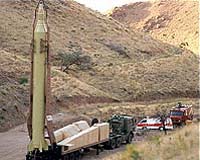
Washington (UPI) Jul 29, 2005 Ballistic missile tensions in the Middle East rose significantly this week when Iran's Defense Minister Ali Shamkhani announced Wednesday that his country had succeeded in developing solid fuel technology for ballistic missiles. "We have fully achieved proficiency in solid-fuel technology in producing missiles," he said. That means Israel's densely populated coastal strip around and north of the city of Tel Aviv -- containing 70 percent of the country's population and 80 percent of its capital infrastructure -- which could be wiped out by a single nuclear strike, is vastly more vulnerable. Solid-fueled missiles can be launched with almost no warning, far more quickly and reliably than liquid fueled ones and they are far more accurate. Iran's intermediate range ballistic missile, the Shahab-3 has a range of 800 miles to 1,000 miles, allowing it to reach Israel. The Shahab-3 was successfully tested in 2002. it is operated by Iran's hard-line Revolutionary Guards. Community Email This Article Comment On This Article Related Links SpaceDaily Search SpaceDaily Subscribe To SpaceDaily Express Learn about nuclear weapons doctrine and defense at SpaceWar.com Learn about missile defense at SpaceWar.com All about missiles at SpaceWar.com Learn about the Superpowers of the 21st Century at SpaceWar.com
 Iran Nuclear Row Coming To A Head Says US Official
 Washington (AFP) Jan 11, 2006
The United States said Wednesday the row over Iran's suspected nuclear arms program was quickly coming to a head and was increasingly likely to end up before the UN Security Council. |
|
|

| The content herein, unless otherwise known to be public domain, are Copyright 1995-2006 - SpaceDaily.AFP and UPI Wire Stories are copyright Agence France-Presse and United Press International. ESA PortalReports are copyright European Space Agency. All NASA sourced material is public domain. Additionalcopyrights may apply in whole or part to other bona fide parties. Advertising does not imply endorsement,agreement or approval of any opinions, statements or information provided by SpaceDaily on any Web page published or hosted by SpaceDaily. Privacy Statement |