|
 |
 |
 |
 |
 |
 |
 |
 |

 |
Iran Becomes Regional Superpower
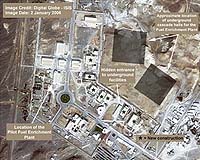
Moscow (RIA Novosti) Dec 29, 2006 Iran may become one of the top 10 features of the outgoing year for a number of reasons, including its nuclear dossier and the Holocaust conference, as well as the anti-Israeli rhetoric of President Mahmoud Ahmadinejad. In short, Iran has made others view it as a regional superpower and the key player in the Middle East. Its nuclear program remains the top issue, with good reason, because it threatens the Non-Proliferation Treaty (NPT). If Iran implements its nuclear program in the proclaimed format, namely on the basis of its own uranium enrichment technologies, this will deal a death blow to the NPT. Iran's program will trigger the domino effect, encouraging Saudi Arabia, Egypt and Jordan to follow suit. The bomb is not the issue, as Iran will most likely decide against creating it. But it will hover merely one step away from it, forcing Saudi Arabia, Egypt and Jordan to cover the same distance. Tehran promises to share its nuclear technology with Kuwait and Syria, which, taken together with Israel's 200 nuclear charges, will turn the region into a nuclear powder keg. There are reasons to suspect that Iran's nuclear program is neither peaceful nor civilian. Its Natanz facility will have 54,000 uranium enrichment centrifuges, and it has already put into operation two cascades with 164 centrifuges each. Iran intends to turn on all of the 54,000 centrifuges. What for? Russian nuclear experts say this number will allow Iran to produce its own nuclear fuel for 20 nuclear power units. So far, Iran plans to turn on only one unit, at the Bushehr nuclear power plant, which is being built with Russia's technical assistance. The unit is expected to be put into operation in September 2007 and start generating electricity in November. The construction of the other 19 units is not planned so far. On the other hand, the same experts say, given the political will, the 54,000 centrifuges can be used to create five to seven nuclear charges within two weeks at the most. Therefore, the International Atomic Energy Agency (IAEA) cannot issue guarantees of the peaceful nature of Iran's nuclear program, although it cannot prove its military goals either. The IAEA has questions to Tehran which it has refused to answer so far, keeping the world on nuclear tenterhooks. The talks on Iran's nuclear program, as well as endless debates by experts, political analysts and other specialists, have turned into a cliffhanger compounded by Iran's intricate diplomatic embroidery. More than three months have passed since the UN's August 31 deadline, by which Tehran should have stopped work on its first cascade of 164 uranium enrichment centrifuges. Since then, Iran has put into operation a second cascade and announced the intention to increase the number of working centrifuges to 3,000 by March 2007. It is certainly bluffing, as it does not have the necessary capacity for this. Yet it has played a joke on the UN Security Council no other country has dared to play before. Ahmadinejad's statements to the effect that "Iran has made a crucial decision and is moving honorably along its chosen path," and that Tehran would consider any Security Council resolution on sanctions as a hostile move are most likely just verbal bravado, which the world has learned to regard calmly. Tehran fears sanctions, or else why did Ali Larijani, head of Iran's Supreme National Security Council, rush to Moscow shortly before the planned stopover in Moscow by U.S. President George W. Bush? Tehran thought President Bush and Vladimir Putin would discuss the Iranian nuclear dossier, and feared that Bush would convince Putin to vote for harsh sanctions against Iran. Tehran needed Russia's support, and Larijani received it. But nothing lasts forever. Putin later said that Russia's support to Tehran was aimed at encouraging it to maintain relations with the IAEA so as to clarify the nuclear watchdog's questions and restore the world's trust in the peaceful nature of Iran's nuclear programs. But it appears that Tehran is not willing to resume talks, at least not now. On December 23, the UN Security Council voted on the Iranian resolution. The permanent members of the council, who form, together with Germany, a six-country group on Iran, have coordinated sanctions against Iran. The resolution proposed by the European Trio, which is negotiating with Iran on behalf of the European Union, differed radically from Russia's stand. Moscow argued that the sanctions should cover only the areas that worry the IAEA - enrichment-related and reprocessing activities and work on all heavy water-related projects, and the development of nuclear weapon delivery systems. The Security Council heeded the Kremlin's arguments, but future developments are almost impossible to predict, especially considering the "Persian motifs" in Tehran's foreign policy. One way or another, Russia's neighbor, Iran, will continue to play a key role in the region, and this is the main result of the story with its nuclear dossier. The opinions expressed in this article are those of the author and may not necessarily represent the opinions of the editorial board.
Source: RIA Novosti Community Email This Article Comment On This Article Related Links Learn about nuclear weapons doctrine and defense at SpaceWar.com Learn about nuclear weapons doctrine and defense at SpaceWar.com Learn about missile defense at SpaceWar.com All about missiles at SpaceWar.com Learn about the Superpowers of the 21st Century at SpaceWar.com
 North Korea Leadership Pleased With A Successful Year Expanding Nuclear Capabilities
 Seoul (UPI) Dec 28, 2006
 North Korea has described 2006 as a "historic year" to build up its military capabilities, boasting its nuclear test in October. But the impoverished country had to sacrifice its struggling economy to build atomic bombs, which could lead to another economic crisis, with strengthening international sanctions. |
|
|

| The content herein, unless otherwise known to be public domain, are Copyright 1995-2006 - SpaceDaily.AFP and UPI Wire Stories are copyright Agence France-Presse and United Press International. ESA PortalReports are copyright European Space Agency. All NASA sourced material is public domain. Additionalcopyrights may apply in whole or part to other bona fide parties. Advertising does not imply endorsement,agreement or approval of any opinions, statements or information provided by SpaceDaily on any Web page published or hosted by SpaceDaily. Privacy Statement |