|
 |
 |
 |
 |
 |
 |
 |
 |

 |
Iowa U: Plasma Noise Burst Welcomes Cassini To Saturn
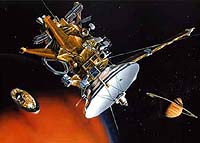
Iowa City (SPX) Jun 30, 2004 Although the Cassini spacecraft is scheduled to officially arrive at the planet Saturn on June 30, scientists studying the planet's magnetosphere received an official welcome on June 27 when a burst of plasma wave noise indicated that Cassini had crossed the planet's bow shock - the region where charged particles flowing outward from the sun collide with Saturn's magnetic field or magnetosphere. University of Iowa Space Physicist Don Gurnett, head of the team that is analyzing radio and plasma wave emissions, says, "This is exciting. After nearly seven years, we finally got there. This marks the beginning of the scientific investigation for the people who will study the planet's magnetosphere." Bill Kurth, Cassini team member and UI senior research scientist, compared the bow shock to a sonic boom. "The bow shock is similar to a jet aircraft sonic boom that forms across the front of the plane. The charged particles flowing from the sun, called the solar wind, pass Saturn and the other planets at a speed of about one million miles an hour. "We can compare the position of the bow shock with the pressure of the solar wind to learn something about the size of Saturn's magnetosphere and how much its size is controlled by the solar wind," he says. The June 27 Cassini bow shock crossing occurred at a distance of 49.2 Saturn radii (2.97 million kilometers or 1.84 million miles) from Saturn and stands in contrast to first encounters by previous spacecraft, all of which took place much closer to the planet. The Pioneer spacecraft first crossed Saturn's bow shock at 23.7 Saturn radii, while Voyager 1 and Voyager 2 recorded crossings at 26.2 and 31.9 Saturn radii, respectively. Gurnett says the difference between Cassini and the other spacecraft is probably due to different flight trajectories. "Cassini has encountered the bow shock quite a bit further out because the spacecraft is coming in from the side of the planet. So our approach angle is different from those of the other craft, primarily because Cassini is going to be placed into orbit about Saturn, while the other spacecraft made fly-bys," he says. Community Email This Article Comment On This Article Related Links Radio Sounds Of Saturn Cassini at JPL Cassini Image Team SpaceDaily Search SpaceDaily Subscribe To SpaceDaily Express Explore The Ring World of Saturn and her moons Jupiter and its Moons The million outer planets of a star called Sol News Flash at Mercury
 Titan's Methane Mystery
 Moffett Field CA (SPX) Dec 12, 2005
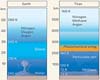
The methane giving an orange hue to Saturn's giant moon Titan likely comes from geologic processes in its interior according to measurements from the Gas Chromatograph Mass Spectrometer (GCMS), a Goddard Space Flight Center instrument aboard the European Space Agency's Huygens Probe. |
|
|

| The content herein, unless otherwise known to be public domain, are Copyright 1995-2006 - SpaceDaily.AFP and UPI Wire Stories are copyright Agence France-Presse and United Press International. ESA PortalReports are copyright European Space Agency. All NASA sourced material is public domain. Additionalcopyrights may apply in whole or part to other bona fide parties. Advertising does not imply endorsement,agreement or approval of any opinions, statements or information provided by SpaceDaily on any Web page published or hosted by SpaceDaily. Privacy Statement |