|
 |
 |
 |
 |
 |
 |
 |
 |

 |
Ion Engines Slowly But Surely Salvage Artemis
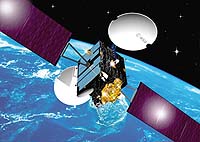
Paris - Feb 22 2002 Thanks to ion propulsion, the Artemis mission is turning near-defeat into a success story. Nominal operations could start this summer, with ESA's satellite, manufactured by Alenia Spazio as prime contractor (I), playing a significant role in the pursuit of high technology and advanced telecommunications. On 12 July 2001, 30 minutes after lift-off from Europe's spaceport in Kourou, French Guiana, it became apparent that the Ariane 5 launcher had propelled the Artemis satellite into a transfer orbit that was lower than expected, with the apogee (the most distant point from Earth) at only 17,000 km rather than the nominal 36,000 km. Under normal circumstances a conventional satellite does not carry enough fuel to compensate for a shortfall in launcher performance of this magnitude. But with an innovative application of ion propulsion (*), a system 10 times more efficient than conventional chemical propulsion, recovery appeared possible. Embedded in a novel and remarkably flexible system design, used with outstanding ingenuity, team spirit and operational skills, Artemis' propulsion capabilities proved to be the key to the rescue of an otherwise lost mission. The initial raising of the orbit, by means of the limited chemical propulsion available, was carried out in less than 10 days by a team of Alenia Spazio, Astrium and Telespazio experts supported by ESA engineers (see ESA press releases 43 and 44/2001). This speed of response was vital to prevent substantial spacecraft degradation by prolonged exposure to the radiation levels of the Van Allen belt. The duration of the firings was calculated to reach a safe parking orbit while retaining some 70 kg of fuel in the tanks, in order to eventually sustain a nominal on-station lifetime of 5 to 7 years. All operations turned out to be extremely successful: with 5 perigee firings the apogee was lifted to 31,000 km. Subsequently, with 3 nominal apogee firings, Artemis was able to reach a circular parking orbit at 31,000 km. Considering the exceptional conditions encountered and due to the perfect performances provided by the spacecraft, both perigee and apogee firings were performed with high efficiency, consuming about 95% of the chemical propellant on board. Preparations for the remaining orbit-raising manoeuvre, using the ion engines, required a considerable amount of work, mainly due to the need to shift the spacecraft from its nominal Earth-pointing to an in-flight pointing orientation. New onboard flight control laws had to be defined and corresponding new software written, tested and implemented under pressure of time. New operational procedures had to be established and hardware configured in a way for which it was not initially conceived. All this turned out to be a very challenging task, never attempted before by Europe on a communication spacecraft. In January 2002 all new software modules were completed and fully tested by Alenia Spazio and Astrium. Today, Artemis starts spiralling out of its safe parking orbit to bridge the gap of some 5000 km at a rate of roughly 1 km per hour. Whereas the initial part of the orbit-raising process, using chemical thrusters, was completed within a few days, the remaining part is expected to last more than 200 days, requiring two ion engines to fire almost continuously. That is because the thrust of these engines is very weak indeed (15 millinewtons). Their task can be compared to driving an ocean liner with an outboard motor. Artemis is expected to arrive this summer at its nominal altitude of 36,000 km. In parallel with orbit-raising preparations, in-orbit verification of the communication payloads was performed. The most spectacular events were communication tests with the CNES (French Space Agency) SPOT-4 Earth observation satellite (see ESA press release 75/2001), during which image data from SPOT 4 were transmitted by laser light to Artemis and from there by radio waves to the Spot Image processing centre in Toulouse. All tests confirmed that Artemis' payloads are healthy and ready to support the technological and operational communication programme. Now the spacecraft is on course for its nominal slot in geostationary orbit. An all but lost mission is on its way to full recovery since Artemis will eventually be able to serve its users from its geostationary position for at least 5 years of nominal operation. Community Email This Article Comment On This Article Related Links Artemis Project SpaceDaily Search SpaceDaily Subscribe To SpaceDaily Express Space Technology News - Applications and Research
 Industry Team Achieve New Communications Technology With AESA Radars
 Baltimore MD (SPX) Jan 12, 2006
A team comprised of three leading US aerospace and defense contractors has demonstrated an innovative technological use of active electronically scanned array (AESA) radars for high-bandwidth communications. |
|
|

| The content herein, unless otherwise known to be public domain, are Copyright 1995-2006 - SpaceDaily.AFP and UPI Wire Stories are copyright Agence France-Presse and United Press International. ESA PortalReports are copyright European Space Agency. All NASA sourced material is public domain. Additionalcopyrights may apply in whole or part to other bona fide parties. Advertising does not imply endorsement,agreement or approval of any opinions, statements or information provided by SpaceDaily on any Web page published or hosted by SpaceDaily. Privacy Statement |