|
 |
 |
 |
 |
 |
 |
 |
 |

 |
Invasive Grass May Impede Forest Regeneration
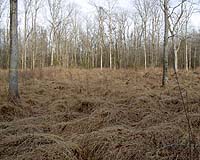
Asheville NC (SPX) Apr 10, 2007 The nonnative invasive grass Microstegium vimineum may hinder the regeneration of woody species in southern forests. Chris and Sonja Oswalt (Forest Service Southern Research Station) and Wayne Clatterbuck (University of Tennessee) set up experiments on a mixed-hardwood forest in southwest Tennessee to study the growth of the invasive grass under different levels of forest disturbance. Study results were published online in the journal Forest Ecology and Management on March 27, 2007. M. vimineum, commonly called Nepalese browntop or Japangrass, was first identified in 1919 near Knoxville, Tennessee, where it was inadvertently introduced in packing material for porcelain china. Since then, the grass has spread across the southern States, flourishing on floodplains and streamsides and displacing native vegetation. "Microstegium can invade and persist in the low-light conditions of interior forests, making excellent use of short bursts of sunlight," says Chris Oswalt. "It can also flourish in the full light conditions that follow many canopy disturbances." While working on a larger oak regeneration study at The Ames Plantation in southwest Tennessee, the researchers noticed a dramatic increase in Microstegium after silviculture treatments that opened the forest canopy. To test whether the grass would negatively impact the regeneration of native woody species, they conducted a separate set of studies nested within the silvicultural study with treatments that ranged from no disturbance to complete canopy removal. After a season of monthly vegetation measures on a total of 720 plots, the researchers found that although Microstegium biomass did not differ significantly among silviculture treatments, there was a significant difference between treated and undisturbed plots, with Microstegium biomass 2 to 10 times greater in disturbed plots. They also found that the species richness of native woody species on the disturbed plots declined as the percent of Microstegium cover increased. "We found that when exposed to sunlight, Microstegium can grow rapidly, often forming thick organic mats on the forest floor that directly impede the regeneration of native woody species by blocking sunlight, and indirectly by blocking seeds from reaching the soil in order to germinate," says Chris Oswalt. "This grass, which can be easily overlooked in the understory, should be given more attention by both researchers and land managers." Funding and support for the study was provided by the University of Tennessee Department of Forestry, Wildlife and Fisheries, where Chris Oswalt is a Ph.D. candidate, the Southern Research Station and The Hobart Ames Foundation. The full text of the article is available at: http://www.srs.fs.usda.gov/pubs/26860 Community Email This Article Comment On This Article Related Links Save the Forests at Wood Pile Forestry News - Global and Local News, Science and Application
 Trees To Offset The Carbon Footprint
 Livermore CA (SPX) Apr 10, 2007
How effective are new trees in offsetting the carbon footprint? A new study suggests that the location of the new trees is an important factor when considering such carbon offset projects. Planting and preserving forests in the tropics is more likely to slow down global warming. |
|
|

| The content herein, unless otherwise known to be public domain, are Copyright 1995-2006 - SpaceDaily.AFP and UPI Wire Stories are copyright Agence France-Presse and United Press International. ESA PortalReports are copyright European Space Agency. All NASA sourced material is public domain. Additionalcopyrights may apply in whole or part to other bona fide parties. Advertising does not imply endorsement,agreement or approval of any opinions, statements or information provided by SpaceDaily on any Web page published or hosted by SpaceDaily. Privacy Statement |