|
 |
 |
 |
 |
 |
 |
 |
 |

 |
Intrusion Endangers Tsunami-Hit Andaman's Stone Age Aborigines
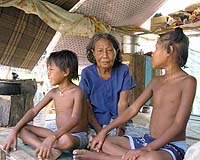
Port Blair, India (AFP) Aug 20, 2005 Intrusion into reserved forests by Indian settlers is posing a threat to reclusive Stone Age aborigines who survived the tsunamis that hit the Andaman island chain last December, environmentalists say. A letter signed by 12 environmentalists said the 350-strong Jarawa tribe, who live in forests of the chain's Middle Andaman island, was being especially targeted by settlers who were also handing out tobacco and alcohol to tribal women in exchange for sex. "The scale of poaching is also far greater than before, with both police and social workers either complicit or callous to these developments," said the letter, sent to India's ruling Congress party supremo Sonia Gandhi. "Further, an alarming increase is evident in the inducements offered to the Jarawas by local villagers... These inducements include additives to create dependencies, so that the Jarawas bring out their most essential produce to feed their addiction," it said. "Repeated reports (also) emerge of intoxicated Jarawa women being available for sex," said the letter, which has been endorsed by the Indian Ocean archipelago's influential Society for Andaman and Nicobar Ecology (SANE). SANE founder Samir Acharya, Austrian ecologist Simron Singh and the 10 others said the letter followed a comprehensive survey of the endangered Jarawas in the archipelago where they and four other tribal groups had lived in virtual seclusion for nearly 60,000 years until 1998 when they developed limited contact with the outside world. "Such contacts increases the risk of sexual exploitation," Acharya told AFP, blaming the Andaman's largely Bengali-speaking settlers for the intrusion into the exclusive forests. The activists said the Andaman Trunk Road (ATR), a 75-kilometre (46-mile) highway slicing through the Jarawa forests, was a key cause of intrusion despite its closure to civilian traffic by the Supreme Court in 2002. "The ATR has become a leading vector for introducing undesirable influences such as alien foods, addictives, diseases and sexual exploitation to the Jarawa. "The ATR remains open in gross violation of court orders and in complete disregard for the rights and the future of the Jarawas," the letter added. A 1957 Indian law prohibits even photography of the aborigines on the federally-administered archipelago. Unsupervised contact with the tribals is also banned. The police said they would investigate the allegations. "But surely if something like this is happening then there would be complaints coming through to us because the Jarawas are in touch with the police as we have outposts all over the forests," Andaman police chief Samsher Deol told AFP. "And we take very stern action whenever such a complaint is made because the protection of these endangered tribals is our responsibility," he added. The number of another tribe, the Great Andamanese, shrunk from 10,000 in 1789 to 49 last year because contact with outsiders brought measles, syphilis and influenza, decimating the ancient community. There are also 200 warrior-like Sentinelese, the 98-member Onge and 250 hunter-gatherer Shompens in the Andaman and Nicobar island chain. Andamans' tribal community also includes 30,000 Nicobarese, many of whom have integrated in mainstream society. Thousands of Nicobarese are listed as feared killed by the tsunamis. The others appear to have survived the tidal waves that wrecked the Indian Ocean chain. Community Email This Article Comment On This Article Related Links SpaceDaily Search SpaceDaily Subscribe To SpaceDaily Express Dirt, rocks and all the stuff we stand on firmly
 Cyber Cowboys And Virtual Shepherds
 Canberra (SPX) Oct 17, 2005
Three recently patented CSIRO inventions are set to provide farmers with the ability to monitor and herd their livestock with no more effort than the push of a laptop button. |
|
|

| The content herein, unless otherwise known to be public domain, are Copyright 1995-2006 - SpaceDaily.AFP and UPI Wire Stories are copyright Agence France-Presse and United Press International. ESA PortalReports are copyright European Space Agency. All NASA sourced material is public domain. Additionalcopyrights may apply in whole or part to other bona fide parties. Advertising does not imply endorsement,agreement or approval of any opinions, statements or information provided by SpaceDaily on any Web page published or hosted by SpaceDaily. Privacy Statement |