|
 |
 |
 |
 |
 |
 |
 |
 |

 |
International Networks Promote Co-Operation In Space Sciences
Brussels - Mar 10, 2004 For more than 20 years, European researchers and academic institutes have fostered international exchanges of students working in space-related physical sciences. Today, trainees from Russia, China and a variety of Eastern European and former Soviet countries are studying in higher learning institutes around the EU. "Our experience of international co-operation in the domain of space-related physical sciences started in 1980," explains Bernard Roux of L3M, the department of Modelling and Numerical Simulation in Mechanics at the University of Aix-Marseille-2. "At that time, bilateral agreements were set up between the CNES (Centre National d'Etudes Spatiales) and the then-Soviet Space Agency Rosaviakosmos, and between the CNRS (Centre National de la Recherche Scientifique) and the Russian Academy of Sciences." With Perestroika, explains Roux, the exchanges were increased, including visits by Europeans to a number of scientific centres in the former Soviet Union. "In 1990," he says, "the exchanges were extended at a multinational level, through the European Space Agency (ESA). We were asked by ESA to report on microgravity research activities in the USSR. This report led to a visit by 12 senior European scientists, from Belgium, France, Germany, Italy, Spain, and Switzerland." The links forged during that historic mission, says Roux, have lasted to this day.
The current crop This network includes four French, five German and three Russian universities as well as two Institutes of the Russian Academy of Sciences. It involves the exchange of 24 Russian doctoral students, half granted by French Ministries (the Ministry of Education and Research and the Ministry of Foreign Affairs), and half granted by the German Academic Exchange Service on behalf of the German Ministry of Education and Research. Meanwhile, RTNs have been integrated into larger international research consortia.
Working with China This partnership was further extended and new partnerships have been developed involving additional Chinese PhD students and additional Labs in France and Belgium. In 1998, a new partnership in the area of Environmental Control and Life Support (ECLS) was initiated with China's ISME (Institute of Space Medico-Engineering), charged with the preparation of the Chinese spaceship Shenzhou. Granted by the French Embassy; the partnership (1999-2003) involved PhD work aimed at investigating ventilation problems.
Looking ahead They have also submitted proposals under the EU's Sixth Framework Programme for a new EU-Russia Network of Excellence in space-related life and physical sciences, as well as a similar initiative including both Russia and the Ukraine. For Roux, the mobility of European and other international students is important to the globalisation of space and the maximisation of its benefits. "We can only hope", he says, "that our efforts have gone some way towards the larger goals of integrating and strengthening the European Research Area and the Higher Education Area at a pan-European level. "One of the drawbacks we see under the present system is that post-doctoral positions and longer-term career opportunities for foreign students offered by American Universities are still more attractive than those offered by France and Germany. "We hope that, with the support of our national and European institutions, we can offer a positive alternative to many of these students, giving them a brighter future in Europe and, in doing so, help to ensure the strength of European space science." Community Email This Article Comment On This Article Related Links SpaceDaily Search SpaceDaily Subscribe To SpaceDaily Express Space Tourism, Space Transport and Space Exploration News
 NASA Refines Design For Crew Exploration Vehicle
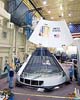 Washington DC (SPX) Jan 12, 2006
NASA's Constellation Program is making progress toward selecting a prime contractor to design, develop and build the Crew Exploration Vehicle (CEV), America's first new human spacecraft in 30 years. |
|
|

| The content herein, unless otherwise known to be public domain, are Copyright 1995-2006 - SpaceDaily.AFP and UPI Wire Stories are copyright Agence France-Presse and United Press International. ESA PortalReports are copyright European Space Agency. All NASA sourced material is public domain. Additionalcopyrights may apply in whole or part to other bona fide parties. Advertising does not imply endorsement,agreement or approval of any opinions, statements or information provided by SpaceDaily on any Web page published or hosted by SpaceDaily. Privacy Statement |