|
 |
 |
 |
 |
 |
 |
 |
 |

 |
Intelligent Robots To Be A Larger Part Of Space Exploration
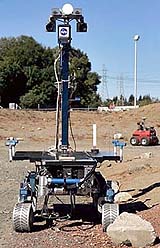
Washington DC (SPX) Oct 07, 2005 Meet Gromit and K-9. They are the two latest robots NASA is using to help improve space exploration. Although they may look similar to the robots already on Mars, Gromit and K-9 have much more complex, built-in intelligence. Loaded with sophisticated software, cameras and spectrometers, these robots can do in 15 minutes what now takes three days. Dr. Liam Pederson is a researcher for NASA. "So that robot there can go to one rock every 15 minutes and actually go to a whole bunch of them and really systematically explore Mars and look for life in a manner which we can't yet do with the vehicles there." The new robots can take samples, gather information and record images. The data can be sent back to Earth almost instantaneously, giving scientists vital information much more quickly. Gromit can even talk with astronauts by voice recognition. The goal is to develop many more high-tech robots before the next mission to the moon in roughly 12 more years. If successful, the robots will have enough autonomy and artificial intelligence to take space exploration further than ever before. NASA scientist David Smith explains. "That's really our job here is to do the stuff that's, you know, out a little bit beyond the horizon and demonstrate that we can actually make it work." The robots will be able to build habitats for future human pioneers, pinpoint promising target regions for joint human-machine exploration and even warn of potentially dangerous areas that might be OK for a machine, but too perilous for humans to approach. Community Email This Article Comment On This Article Related Links SpaceDaily Search SpaceDaily Subscribe To SpaceDaily Express All about the robots on Earth and beyond!
 Penn Surgeons Use Completely Robotic Surgery To Treat Prostate Cancer
 Philadelphia PA (SPX) Oct 07, 2005
Prostate cancer is the second leading cause of death among American men. It is estimated that one in six males will develop the disease during his lifetime. However, promising new treatment options have been developed to help combat this threatening disease. |
|
|

| The content herein, unless otherwise known to be public domain, are Copyright 1995-2006 - SpaceDaily.AFP and UPI Wire Stories are copyright Agence France-Presse and United Press International. ESA PortalReports are copyright European Space Agency. All NASA sourced material is public domain. Additionalcopyrights may apply in whole or part to other bona fide parties. Advertising does not imply endorsement,agreement or approval of any opinions, statements or information provided by SpaceDaily on any Web page published or hosted by SpaceDaily. Privacy Statement |