|
 |
 |
 |
 |
 |
 |
 |
 |

 |
Insects' Giant Leap Reconstructed By Founder Of Sociobiology
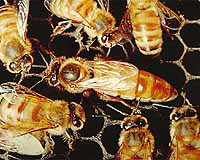
Washington DC (SPX) Jan 03, 2008 The January 2008 issue of BioScience includes an article by biologist Edward O. Wilson that argues for a new perspective on the evolution of advanced social organization in some ants, bees, and wasps (Hymenoptera). Wilson's article surveys recent evidence that the high level of social organization called "eusociality," found in some Hymenoptera (and rarely in other species), is a result of natural selection on nascent colonies of species possessing features that predispose them to colonial life. Wilson concludes that these features, principally progressive provisioning of larvae and behavioral flexibility that leads to division of labor, allow some species to evolve colonies that are maintained and defended because of their proximity to food sources. Eusociality is a challenge for biologists to understand because worker castes in eusocial species forgo individual reproduction but rear young that are not their own, a behavior that biologists label altruistic. Wilson's current view about eusociality differs from the assessment in his seminal book Sociobiology: The New Synthesis (1975). According to that widely accepted earlier account, selection acting on individuals that are related (kin selection), rather than on whole colonies, explains eusociality in Hymenoptera. Kin selection is thought to be especially powerful in these animals because of an unusual genetic system, known as haplodiploidy, that they share. Wilson's survey in BioScience, which examines the findings of a number of researchers, points out aspects of the occurrence of eusociality that the standard explanation has difficulty accounting for. Eusociality has evolved only a few times, and not all of them were in haplodiploid species. Furthermore, the great majority of haplodiploid species are not eusocial. Wilson holds that selection acting on traits that emerge at a group level provides a more complete explanation for eusociality's rare instances than kin selection. Kin selection is, he writes, "not wrong" but incomplete. The view Wilson advocates is controversial because theoretical biologists have thus far been unable to create mathematical models that demonstrate the strong colony-level selection that Wilson postulates. Any theory about eusociality has to explain why selection acting on individuals does not lead some to undermine the colony by reproducing themselves. According to some of Wilson's critics, the theory he now espouses relies on unacknowledged individual-level selection rather than group selection. Community Email This Article Comment On This Article Related Links American Institute of Biological Sciences Darwin Today At TerraDaily.com
 Study Says 2000 Tigers Possible In Thailand
 New York NY (SPX) Jan 03, 2008
Thailand's Western Forest Complex - a 6,900 square mile (18,000 square kilometers) network of parks and wildlife reserves - can potentially support some 2,000 tigers, making it one of the world's strongholds for these emblematic big cats, according to a new study by Thailand's Department of National Park, Wildlife, and Plant Conservation and the New York-based Wildlife Conservation Society. |
|
|

| The content herein, unless otherwise known to be public domain, are Copyright 1995-2007 - SpaceDaily.AFP and UPI Wire Stories are copyright Agence France-Presse and United Press International. ESA Portal Reports are copyright European Space Agency. All NASA sourced material is public domain. Additional copyrights may apply in whole or part to other bona fide parties. Advertising does not imply endorsement,agreement or approval of any opinions, statements or information provided by SpaceDaily on any Web page published or hosted by SpaceDaily. Privacy Statement |