|
 |
 |
 |
 |
 |
 |
 |
 |

 |
Insect Noses' The key To Cybernose Collaboration
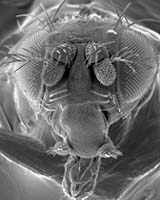
Canberra, Australia (SPX) Aug 16, 2006 A new $4 million collaboration announced today will help scientists in their efforts to produce a new generation of electronic nose, the 'cybernose'. Researchers in the collaborative Cluster between The Australian National University, Monash University and CSIRO's Food Futures National Research Flagship are trying to understand how simple animals make sense of smells. The microscopic nematode worm will be central to the cybernose research due to its highly sensitive molecular recognition system, allowing it to sense smell and flavour qualities in grapes. The cybernose will involve putting sensor proteins from insects and nematodes in to an electronic nose to replace the current generation of electronic sensors that are not discriminating enough. The cybernose may also be used in future across other sectors of the food and beverage industries and, in the long term, the cybernose technology could be developed to enhance Australia's biosecurity by detecting and intercepting pests and diseases The Minister for Education, Science and Training, Julie Bishop, has announced the first round of Flagship Collaboration Fund Cluster funding, designed to facilitate the involvement of the wider Australian research community in addressing the critical national challenges targeted by the Flagships. As part of the $305 million over seven years provided by the Australian Government to the National Research Flagships, $97 million was specifically allocated to further enhance collaboration between CSIRO, Australian universities and other publicly funded research agencies. The Flagship Collaboration Fund enables the skills of the wider Australian research community to be applied to the major national challenges targeted by CSIRO's Flagship Initiative. The University Cluster partners will receive $2.2 million from the Flagship Collaboration Fund over two and a half years. This money will be matched in-kind by ANU and Monash. Dr Bruce Lee, Director of the Food Futures Flagship, says that the Olfactory Pattern Recognition Research Cluster is one of the first Clusters to receive funding from the Flagships Collaboration Fund and university partners. "This is the first time that we've had a real opportunity to collaborate with CSIRO to build on basic science to generate a potentially extremely useful technology," says Cluster leader, Professor Mandyam Srinivasan from ANU. "It is very exciting that the research will have applications in a number of industries." Dr Coral Warr from Monash University says the collaborative cluster is an exciting opportunity. "It is bringing together Australian olfaction researchers using very different approaches to solve a common problem - how do animals detect and discriminate odours," Dr Warr says. She says that participation in the Flagship Cluster has enabled her to bring to Australia one of the foremost insect olfactory electrophysiologists, Dr Marien de Bruyne, thus enabling her group to study odorant receptor function in the fruit fly Drosophila in entirely new ways. "The information we generate about how these receptors function will directly benefit CSIRO's development of olfactory biosensors," Dr Warr says. Although the applications will be numerous, in the first instance, the group is working with the wine industry. "The Cybernose will draw on how the brains of simple organisms such as insects and tiny nematode worms process information about smells and tell the difference between related odours," says Dr Trowell, the Flagship theme leader. "By 2013, we aim to have, in wineries around Australia, a Cybernose that will enable the wine industry to objectively measure aroma and flavour - a more reliable measure than chewing some grapes. "This will enable winemakers to pick grapes at the time of optimum ripeness and even to tailor the style of wine precisely and so improve its value. This has the potential to contribute $750 million annually to the industry." Community Email This Article Comment On This Article Related Links All about the technology of space and more All about the robots on Earth and beyond!
 iRobot To Deliver PackBot Robots To German Federal Defense Force
 Burlington MA (SPX) Aug 13, 2006
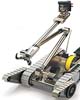
iRobot Corp. has announced it has signed an agreement with the German Bundeswehr (Federal Defense Force) to deliver 18 iRobot PackBot EOD robots, spare parts and repair services this year, with a follow-on option for 22 additional robots in 2007. The bomb disposal robots will be used by German forces to identify and dispose of Improvised Explosive Devices (IEDs). |
|
|

| The content herein, unless otherwise known to be public domain, are Copyright 1995-2006 - SpaceDaily.AFP and UPI Wire Stories are copyright Agence France-Presse and United Press International. ESA PortalReports are copyright European Space Agency. All NASA sourced material is public domain. Additionalcopyrights may apply in whole or part to other bona fide parties. Advertising does not imply endorsement,agreement or approval of any opinions, statements or information provided by SpaceDaily on any Web page published or hosted by SpaceDaily. Privacy Statement |