|
 |
 |
 |
 |
 |
 |
 |
 |

 |
Inflating Mars
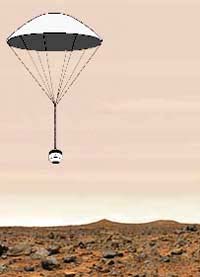
Sydney - Sept. 11. 2001 "All creatures great and small" could be an appropriate metaphor for the menagerie of probes that NASA would like to send to Mars. Despite budget shortcomings that could threaten NASA�s Scout program for small missions, engineers are pressing ahead with plans for a large rover that is tipped to fly in 2007. There could also be other spacecraft of various descriptions in the same time frame, but it�s difficult to predict their nature with absolute certainty. Whatever the case, the uncertainty and regular revision phases that have governed Mars exploration since the mid nineties do have an upside. They provide us with plenty of opportunities for suggesting new missions that could have been frozen out of a more rigid long-term plan. One thing that appears reasonably certain is that, in the long term, NASA will need to return to big landers. The proposed 2007 mission is a prime example. Big landers are essential for carrying large rovers, and without them, sample return won�t be an option. Big landers also carry another advantage that isn�t generally discussed in the media. There�s plenty of room underneath the big aeroshells that will carry them through the Martian atmosphere. Engineers generally try to fill as much space inside an atmospheric capsule as they can, with the design of both the aeroshell and the spacecraft it encloses being so closely matched. But there are still likely to be odd pockets of empty space in some areas of the enclosure. Furthermore, a large spacecraft will also require small amounts of ballast in some places, to ensure that it remains aerodynamically stable during its descent. This presents us with an opportunity for some Martian stocking-fillers. One of the easiest ways to do this is to include a small balloon in the first large lander. So far, only two balloons have flown outside of Earth. In 1985, the Soviet Union dropped two simple ones into the atmosphere of Venus during the Vega missions. These were highly successful, returning atmospheric data for several hours. Scientists have been planning to send balloons to Mars for decades, but none have even reached the flight approval stage. The first Martian balloon would probably be similar in size and capabilities to its Venusian counterparts. It would be a simple helium sphere with no sophisticated navigational capabilities. A small instrument package, powered by a battery, would send data to an overhead orbiter. The balloon would carry atmospheric sensors and a small CCD camera. Like the Vega balloons, it would unfurl during the descent phase, emerging soon after the aeroshell released the lander. The balloon�s mission could begin before it even inflates. The CCD camera could be used to photograph the lander as it falls out of the backshell, and confirm that this critical phase of its descent has occurred successfully. Soon afterwards, the balloon itself would drop free, a small package containing a deflated balloon, a gas cylinder, and the instrument package. It would continue to photograph the surface as it fell, possibly spotting the lander again. This would provide a backup to any images of the landing site taken by the lander�s own descent imager. The balloon would inflate, then drop the gas canister. The balloon would carry temperature and pressure sensors. Its radio would also serve as a means of tracking its motion in the Martian breeze, thereby providing an active atmospheric experiment. The sensors carried by the balloon could be identical to those developed for the proposed Pascal mission to Mars, currently under evaluation as a Mars Scout proposal. This would save development costs for the balloon, and also verify the performance of these sensors. Imagery from the balloon would be of a higher resolution than most orbiters could generate, and would cover a fairly wide area, depending on the wind. The camera could also be used to investigate dust and cloud activities in situ, a feat not possible with either orbiters or landers. The balloon could function for more than a single Martian day, if power conservation is carried out. It would not take much power to operate the sensors, and telemetry could be carried out in a burst form at predetermined intervals. This could give scientists a change to observe the balloon�s behaviour in a complete day-night cycle. The balloon could be designed to slowly leak its gas, allowing the instrument package to descend to the surface at a distance far away from the main lander. This would permit a close-up examination of another region as it descended, as well as testing atmospheric conditions immediately close to the surface. A balloon package would not be very expensive or complex to develop. It would complement the mission that carried it by providing data collected in roughly the same place, at the same time. Once the concept has been tested, a balloon package could be a standard element on every large aeroshell that is sent to Mars. Future balloons could be geared as delivery systems for small surface science packages that would investigate soil chemistry, or even drop nanorovers similar to the one NASA originally planned to send on Japan�s Muses CN asteroid mission. Eventually, a large aeroshell could fall into the Martian atmosphere containing nothing but a balloon. This would be a much larger, longer-lasting craft with navigational control. Such a balloon could perform the long-expected sky to ground tour, deflating at night to visit the surface, and inflating with solar heat during the day to lift off again. If the 2007 launch window is to be used, planning should begin now. Any takers? Morris Jones is a Sydney, Australia-based journalist and consultant. He can be contacted at morrisjonesNOSPAMhotmail.com. Replace NOSPAM with @ to send email. Community Email This Article Comment On This Article Related Links SpaceDaily Search SpaceDaily Subscribe To SpaceDaily Express Mars News and Information at MarsDaily.com Lunar Dreams and more
 Spirit Heading To 'Home Plate'
 Pasadena CA (JPL) Jan 09, 2006
Last week Spirit completed robotic-arm work on "El Dorado." The rover used all three of its spectrometers plus the microscopic imager for readings over the New Year's weekend. |
|
|

|
|
|
|
|
|
|
|
|
|
|
|
| The content herein, unless otherwise known to be public domain, are Copyright 1995-2006 - SpaceDaily.AFP and UPI Wire Stories are copyright Agence France-Presse and United Press International. ESA PortalReports are copyright European Space Agency. All NASA sourced material is public domain. Additionalcopyrights may apply in whole or part to other bona fide parties. Advertising does not imply endorsement,agreement or approval of any opinions, statements or information provided by SpaceDaily on any Web page published or hosted by SpaceDaily. Privacy Statement |