|
 |
 |
 |
 |
 |
 |
 |
 |

 |
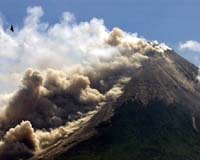
Indonesias Merapi Roars Back To Life
Mount Merapi, Indonesia (AFP) Jun 09, 2006 Indonesia's Mount Merapi roared back to life Thursday, belching its largest clouds of hot gas and ash yet and sparking panic among residents already jittery from last month's quake. Television footage showed stunning clouds spewing from the volcano's crater against a clear blue sky just after 9:00 am (0200 GMT). People rushed to evacuation points lower down the slopes, fearful they would be engulfed. The vulcanology office in Yogyakarta, 30 kilometres (18 miles) south of Merapi, said the clouds reached almost five kilometres down the southeastern slope, but not as far any inhabited areas. The village nearest the peak to the southeast, Kinahrejo, lies about 6.5 kilometres down the slope. Misman, a local official in Umbulharjo village, told AFP that some residents in another hamlet seven kilometres from Merapi's bubbling crater had panicked after being surprised by the clouds. "There was some panic, as people near Kaliadem saw the huge clouds, especially because it has been a long time since such clouds headed this way," the official said. Metro TV showed residents, including weeping women carrying their infants, waiting for evacuation by trucks and cars provided by the district governments at designated spots in the danger zone. The video footage, taken by its cameraman with other reporters fleeing on board a speeding car, also showed several villagers running or riding motorcycles down the main road. Ratdomo, a senior geologist at the office, said on ElShinta radio that the cloud was "not extraordinary. It has already happened several times. "The only thing is that it happened in the morning when the sky was clear so that everyone could see it," he said. The volcano on densely-populated Java island was put on its highest alert on May 13, meaning it was considered poised to erupt. Its activity has been erratic since then but escalated again since the deadly May 27 earthquake. The quake, which struck the region in and around Yogyakarta, killed more than 5,800 people. In the first six hours of Thursday, Merapi sent 19 other clouds to the southwest and southeast, reaching up to four and a half kilometres. The clouds, known locally as "shaggy goats", consist of volcanic gases, ash and dust. Multiple lava flows also streamed two kilometres down Merapi's flanks, the office said. Indonesian air authorities issued a warning to planes to avoid flying near the volcano -- whose name means "Mountain of Fire" -- although the airport in Yogyakarta remained open. The warning "was issued this morning and basically asked all flights to avoid flying near Merapi for their own safety," transport ministry spokesman AJ Barata told AFP. Meanwhile officials said more than 18,000 people had left their homes on the higher slopes of the volcano by early Thursday for temporary camps. Edy Susanto, deputy chief of the disaster agency in Magelang district, said the camps "badly needed" volunteers as well as tents, walkie-talkies and utilities for kitchens, as most was moved to help with quake relief efforts. "We understand that they need more help than us but our resources are also depleted because of the quake and we are not getting new equipment or help from the local and central governments," he told AFP. Officials in the quake zone, which lies south of Merapi, said separately Thursday that they had cleared up confusion over the distribution of cash and rice which had hindered disbursement to survivors.
Source: Agence France-Presse Community Email This Article Comment On This Article Related Links - Bringing Order To A World Of Disasters When the Earth Quakes A world of storm and tempest
 New Study Shows Earthquake Shaking Triggers Aftershocks
 Santa Cruz CA (SPX) Jun 09, 2006
A new analysis of earthquake data indicates that aftershocks are triggered by the shaking associated with the mainshock, rather than by the added stress on nearby faults resulting from rearrangement of the Earth's crust. |
|
|

| The content herein, unless otherwise known to be public domain, are Copyright 1995-2006 - SpaceDaily.AFP and UPI Wire Stories are copyright Agence France-Presse and United Press International. ESA PortalReports are copyright European Space Agency. All NASA sourced material is public domain. Additionalcopyrights may apply in whole or part to other bona fide parties. Advertising does not imply endorsement,agreement or approval of any opinions, statements or information provided by SpaceDaily on any Web page published or hosted by SpaceDaily. Privacy Statement |